Category Archives: All articles

Singin’ U.S.A.


“Is it me, or people making a bit more effort than usual with their appearance?”

It’s Sunday, and Mimi and I are doing our makeup at the Barbican in preparation to sing.  We are singing songs from America, from Copland’s arrangement of a number of old American songs (you might almost call them folk songs) to modern songs by Morten Lauridsen and Eric Whitacre.  The choir has been on a journey which is not unusual when we learn something new.  Along the way we have struggled with the challenges involved in learning new (and especially contemporary) pieces.  This is the phase in which we are most likely to dismiss the pieces as being not very good.  Now, though, whilst still feeling a little nervous, we are starting to catch ourselves singing snatches of the songs.  We are ready to perform.

We have been on a journey of another sort with our conductor – and composer of some of the songs we shall be singing – Eric Whitacre.  He is younger than many of the conductors we sing with and brings the kind of beach-blond good looks which are often associated with California, where he lives with his wife and young son.  His compositions, whilst contemporary, are tonal – tuneful – in a way which is not fashionable in the world of new music.  What’s more, in his rehearsals with us, Eric’s manner is quite unlike that of many of the conductors we work with, combining confidence with humility and an unusual dose of openness – letting us know, for example, how it is for him to hear the Songs of Immortality, which will be premiered for the first time tonight, being sung for the first time.  Behind the scenes the chorus “chatter” suggests an ambivalence towards him, both drawn to his good looks and his openness of manner and slightly wary.  This is not what we’re used to.

Whitacre is a modern composer in another way.  His website (at http://www.ericwhitacre.com/) is thoroughly modern in its use of the possibilities of modern social media.  It includes a blog, twitter and facebook page as well as a photo gallery (from which I have taken the photo above) and examples of his music.  After he discovered a recording by a young woman of his piece Lux Arumque on YouTube he invited singers to record their line and created a virtual choir performance.

What of our concert?  This, too, was a thoroughly modern affair.  Whitacre introduced each piece or cycle with his trademark directness, openness and honesty to which the audience clearly responded warmly.  His wife, soprano Hila Piltmann, sang Barber’s Knoxville:  Summer of 1915 with an assurance and simplicity that moved me.  The choir (if I may say so – I am not without bias) rose to the occasion, singing with our trademark gusto and even with a bit of polish here and there.  I loved the challenge of the Songs of Immortality and was moved almost to tears by the rising crescendi in Sleep.

I was moved, too, by Whitacre himself.  For he was never less than completely gracious in his dealings with everyone involved.  For this, as much as for the beauty of his music, I am deeply grateful.
Falling in love with Janacek, our beloved Sir Colin and Simon O’Neill

I am following up after a first meeting with a new coaching client.  I have promised to send her links to whatever postings I have already written (and possibly to write another) on the subject of appreciation.  As I scan through the postings that sit under the label “celebrating” I am struck by several that relate my experiences of singing with the London Symphony Chorus.  I smile, for I am in the midst of one such experience right now and – not for the first time – find myself falling in love.

We have been rehearsing Janacek’s Glagolitic Mass which we performed on Sunday and will perform again this evening.  It is a challenging piece with entries for the chorus which are hard to place even whilst requiring great precision.  We have been told that, in its original version, it was deemed too difficult to sing so that Janacek was asked to re-write it.  It is not to everyone’s taste – I know of one member of the chorus whose choice it is not to sing this piece – and still, it is to my taste.  I love the exuberant proclamation of faith that is written into the text and resonate to a quote from Edward Seckerson, music critic for The Times, when he says:  “One way of looking at Janacek’s Glagolitic Mass is to imagine that the voices raised in affirmation and outrage are those of pagans who have been Christian for about a week”.  This is music that brings a fresh eye – and voice – to the liturgy.

Sir Colin Davis is our maestro for the evening and an old friend through our many years of singing under his baton with the London Symphony and other Orchestras.  When my niece asks me, following our Sunday morning rehearsal, how I see the role of conductor, I reflect on the preparation we have had to sing as well as on the extent to which we rely on Sir Colin for those difficult entries.  It’s not just that he has prepared us for this piece.  Over the years we have heard him remind us (many times!) to come in early and “don’t chew the vowels!”  As I write I feel grateful for the opportunity to sing with him over a number of years and for his ongoing quest for performances that are sharp at the edges, lacking in any sentimentality and still, full of truth.

Beyond this, I feel a slight twinge of guilt as I prepare to single out any one of the musicians.  The soloists are wonderful, including Catherine Edwards on the organ.  Still, I have to say that it’s Simon O’Neill who has won my heart.  We have sung with him before, notably when he stood in at short notice to sing the title role of Otello in December 2009.  I hesitate to describe his performance, fearful of tripping over the critics’ vocabulary for a tenor of O’Neill’s gusto.  At the same time, it doesn’t do justice to his finesse to say, simply, that he really gave it some welly!  Over and above his singing, the fact that he had it in his heart, after such a demanding performance, to acknowledge the chorus amidst the takings of bows, gives him a place in my heart.  I love this act of appreciation from one singer to another.

Perhaps you will be in the audience tonight when we sing again.  I hope so.  And if not you will have to wait until our performance is released on the LSO Live label.  Perhaps you, too, will fall in love with Janacek, with our beloved Sir Colin and with Simon O’Neill.

Thinking of all the mirrors in my bedroom

This morning I am thinking of all the mirrors in my bedroom.

Well, perhaps I should be more precise.  I am thinking of all the meta-mirrors in my bedroom.  The meta-mirror is a technique from neuro-linguistic programming (or NLP) which helps people to transform negative feelings towards another person and to take the learning from a situation that will help to release feelings of anger, frustration and more.  As a technique, it’s easy to learn and easy to apply.

NLP often uses physical space in the process of making mental distinctions and the meta-mirror is no exception.  This is why I think of my bedroom when I think of the meta-mirror.  It’s not only that I like to use this ample space when I want to process some feelings I have about a person or situation.  It’s also that on the rare occasions when I am feeling angry or frustrated, it makes sense to do this processing before I go to bed in order to be able to get a good night’s sleep.

Over time, using this technique seems to build in a muscle that is pre-emptive.  The anger and frustration is less right from the beginning because the ways of thinking that produce it are changing.  There’s no “sainthood” involved – just an ongoing process of learning.

Over the years I have taught this technique in various settings and found it invaluable.  I still remember teaching it to a group of headteachers as part of a training in coaching skills.  I like to demonstrate it before having participants try it out themselves.  Later, the headteacher who had been my demo subject on that day told me the experience had changed his life.

Frogs Into Princes

The trouble with many professional ethical codes, whether they are humanistic, analytic or anything else, is that they limit your behaviour.  And whenever you accept any “I won’t do it,” there are people you are not going to be able to work with.  We went into that same ward at Napa and I walked over and stomped on the catatonic’s foot as hard as I could and got an immediate response.  He came right out of “catatonia,” jumped up, and said “Don’t do that!”
Frogs Into Princes
Richard Bandler and John Grinder
Richard Bandler and John Grinder, the originators of what has become widely known as Neurolinguistic Programming, or NLP, began their work when they set out to study the work of some of the most effective therapists of their era, including Milton Erikson, Fritz Perls and Virginia Satir.  Frogs Into Princes, first published in 1979, is compiled of live transcriptions of some of their early seminars.
I must confess that, prior to studying NLP through a number of Practitioner, Master Practitioner and Coach programmes (where I chose to follow up on my own initial participation by becoming a member of the teams that supported these trainings to further my learning), I found reading about NLP about as easy a way to learn as learning Chinese by reading Mandarin.  I just didn’t get it.  Later, when I had already completed my NLP Practitioner, I made a mental note when a colleague told me that, for her, reading Frogs Into Princes was the experience that had first brought NLP alive.  And when I found a copy recently for less than twenty pounds I decided to buy it.
Reading it, I can see that it has something for everybody.  For the reader who is new to NLP it contains many examples of the ground NLP has covered, from specific techniques (re-framing and the phobia cure to name just two) to a number of assumptions which have become guiding principles of NLP.  The example given at the top of this posting illustrates at least two of them:  If what you are doing is not working, change it.  Do anything else and The meaning of the communication is the response you get.
For the seasoned Practitioner, Frogs Into Princes offers insight into Bandler and Grinder’s work, including the initial context in which they worked and the work itself.  They really did mean it when they encouraged you to try something else – anything else – if what you are not doing is not working.  I laughed out loud when I read the example given above and a number of other examples.  I was also reminded of the power of NLP to open up any number of new possibilities to the practitioner in his or her own life and in the lives of the people with whom he or she lives and works.
I talk about the people we work with in the broadest terms because NLP has expanded in its application way beyond the therapeutic field in which Bandler and Grinder originally studied.  The lessons of NLP are available to be applied in every area of life.  NLP can help the most senior leaders to share their visions in ways which capture the imaginations of those they lead.  NLP can help the classroom teacher to adjust his or her approach in order more effectively to support individual pupils.  NLP can help the husband or wife, at his or her wits end, learn how better to communicate with his or her partner.
I would add, almost as a PS, that there is one criticism that has often been levelled at NLP, that it is in some way manipulative.  If you want to form your own view of this, you could do worse than read Frogs Into Princes.  Who knows, you might well discover that turning your own frog into a prince begins with you.  NLP is, above all, about self-mastery.
PS Just to let you know, as a member of Amazon Associates UK, I shall receive a referral fee for any books you buy using the links in this posting.

Championing your inner parts

Have you noticed how, when you are in conflict with yourself, there’s a part of you you champion and a part of you you like to tell to p*ss off?  Which part you champion depends on the values you espouse and still, you are unusual if you champion yourself in the full glory of all your parts.  So, a part of you basks in the light of your approval whilst another part of you prowls around in the shadows.  And guess what, it is rarely the part you champion that “wins”.

The result can be a kind of inner stasis, even whilst you are seeking to move forward.  You want to write that proposal or to phone that client or to stop eating chocolate or… or… or…  And yet, somehow, when it comes to the crunch, you are guided by the part of you you most condemn.

Some thinkers view these “shadow” parts as gremlins to be conquered – overcome by force in order to make way for those parts we most favour.  I prefer to view them differently.  For each part has a positive intention even if the means by which that intention is made manifest is unhelpful at this stage of our lives.  When we respond to the different parts of ourselves we can afford to champion them all, to take time to ask “what is it that you really want for me?” and to thank each part for acting as the guardian of this positive intention.  Only from this position of embracing our different parts can we begin the journey towards finding new ways to fulfill old intentions.

In case you want to take a new approach and to connect with your parts in conflict, here are some steps you can take to get started:

  • Start by saying hello to each part in turn.  You may be surprised and still, they will answer back;
  • Let them know that you’d like to spend some time with each part in turn and ask them, will they let you do this without interrupting each other?  If you get a “no” you might like to ask what’s needed before each part feels comfortable to give the other space;
  • Take time with each part in turn – how about five minutes with one and then a break before five minutes with another?  Let each part know that you trust that it has positive intentions and be honest with either part if you have not understood what its intentions are.  If you don’t know, ask!
  • You might like to take time every day for this over several days.  Notice how open you are to hearing what each part wants for you;
  • Say “thank you” to each part for his or her good intentions for you.  When you can say thank you with full sincerity you are ready to be the champion of your inner parts, just as they have been seeking to champion you.  And guess what!  Since each part is just that – a part of you – you are, in this way, championing yourself.

As a footnote, I would add that whilst you may value the intentions each part has for you, you may find its way of fulfilling its intentions highly frustrating.  At the same time, if you want to agree new ways to fulfill those intentions, you will need to do this from a place of mutual respect and appreciation – that’s between you and your different parts.

From the stable of NLP: “parts integration”

Jamais deux sans trois, as the French would say.  It seems to me that all my clients are bringing inner conflict to our coaching right now.  This is hardly surprising since we all, at times, experience the inner voices that seem to be in conflict with each other.  The clues are in our language (“on the one hand… and on the other hand…”), in the way we feel (typically, torn) and in our vision of two diametrically opposed options.

The manifestation of these parts is diverse.  For one person it is the part that wants to earn masses of money versus the part for whom money is just not important.  For another person it is the part that wants to stay in a job even though it’s desperately dull versus the part that wants to say “to hell with it” and leave in search of something more exciting.  For a third person it is the part that wants to share just how much she loves her new partner versus the part that wants to take things one step at a time.  Even as I write I wonder if, at root, our conflict is between the part of us that wants to keep us safe and the part of us that seeks adventure – maybe even to pursue our true calling.

Beneath this inner conflict lie assumptions that are untested or which may be understood at some cognitive level and which have not yet been understood or integrated into our bodies or way of being.  The mother of all assumptions is, of course, that the causes that our inner voices are championing are mutually exclusive.  It’s not unusual for people to recognise and celebrate one part of themselves whilst seeking to repress the other part – and guess what, the part we are least inclined to sponsor always finds a way to express itself, to hold sway.

It’s not often, as a coach, that I offer to step away from pure coaching to provide an intervention from the set pieces of neurolinguistic programming (or NLP).  At the same time, I recognise the elegance of NLP’s “parts integration”, which facilitates a dialogue between inner parts in conflict, helping each part to hear the aims of the other and helping both parts to come together to collaborate in meeting aims which were seen as mutually exclusive and are now understood to be perfectly compatible.

In truth, this integration of our inner parts is an ongoing journey rather than a one-off event.  It is part of a journey towards self-acceptance and it is significant as a contribution to our inner peace as well as to creating lives that are productive and fulfilling.

If you want to learn more, keep an eye on this blog – I sense this is a topic to which I shall return.  If you want to experience the NLP “parts integration”, seek out an NLP Practitioner to support you.

Celebrating my mother on her 80th birthday

My mother has resolutely resisted the computer age and won’t be reading my blog today or any other day.  And that’s OK.  Still, this won’t stop me celebrating her today, on her 80th birthday.

There are many words I could say and many things I could celebrate and still, words will not be enough.  How can you begin to do justice to eighty years of life and living in a single blog posting?

Maybe I should add, how can you begin to do justice to eighty years of supporting life and supporting others in their living, including the lives to which she herself gave birth?  For as well as giving birth to her own four children, Mum has supported the lives of many, from the children to whom she was House Mother at Beenham Lodge Children’s Home, to her own children, her sister (I especially remember Mum’s support to her sister after the birth of her first children, my twin cousins), her parents in their mature years, her husband (my father)… right through to the men and women she still cooks for at the Vintage Club in Woolhampton.  And that’s without taking in the many animals she cared for during her years of farming and the plants she tends in her garden and allotment.

And then there’s the question of how many wedding dresses she has made over the years, and wedding cakes, and birthday cakes and – well, the list would be long.  Only this week, she made a birthday cake (Mr Sneeze) for the fifth birthday of her grandson Joel.  Oh!  And how many concerts she organised for St. Peter’s Church, Woolhampton, before gracefully retiring just two years ago.

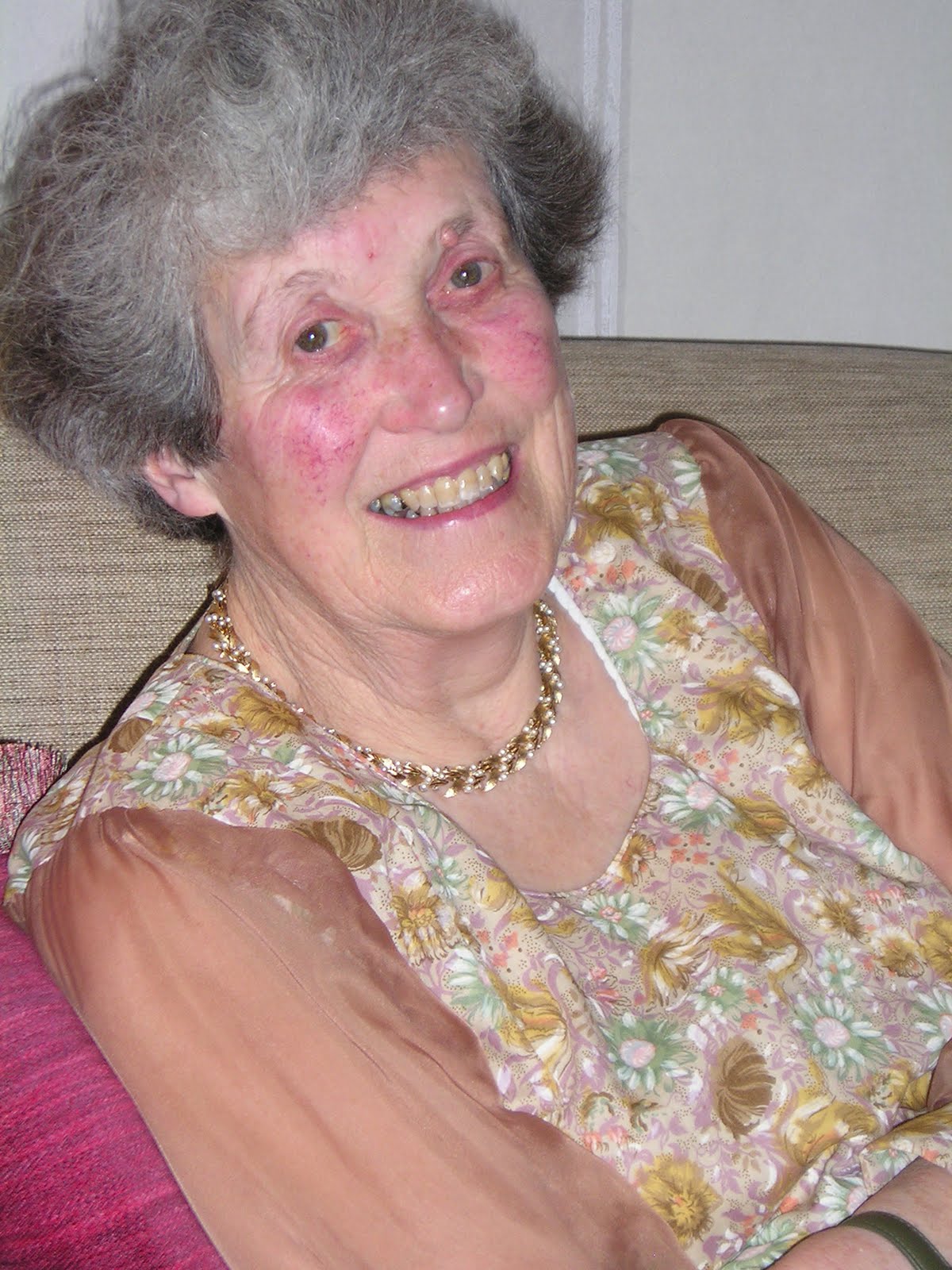
With so much more that could be said and knowing that no words could do her justice, I give you my mother, Stella Nesbit, on her 80th birthday.  Here she is at my cousin’s wedding just a couple of years ago:

Making peace on peace day

Our news is often filled with evidence of conflict on a grand scale. It can give the impression that conflict is a large-scale affair taking place some way away and in which, by implication, many of us have no part.

Yet the most cursory survey can remind us of the conflict that is in our lives. Perhaps you have some inner conflict that is leaving you feeling torn right now – for whatever reason. Perhaps you are aware of some conflict in your workplace, barely expressed but simmering and visible. Perhaps, as you survey your immediate and extended family, you notice myriad major and minor disagreements which, over time, have been written into the ongoing “story” of your family.

Today, 21st September, is Peace Day, an annual day whose significance is growing around the world. You can find out about Peace Day by watching two short videos at the Pathfinder website or by going to http://www.peaceoneday.org/.

In talking about peace, I’d like to mention the work of Marshall Rosenberg (as I have done many times) author of Nonviolent Communication: A Language for Life. Marshall has dedicated many years to evolving and sharing a way of communication which promotes peace.

Ban Ki-Moon, Secretary General of the United Nations, asks in the short films I mention above: “What will you do to make peace on 21st September?” I offer the following suggestions for any reader who is seeking inspiration and I also invite you to share via the comments box below: What did you do today to make peace and with what outcomes?

Here are my suggestions:

  • Try peace on for size: take five minutes to contemplate a world in which peace is the norm. As you imagine this world, notice what it evokes in you – what feelings, thoughts and so on. And if you find yourself thinking “yes, but” let go of the gap between now and peacetime and step back into living in a world in which peace is the norm;
  • Take ten minutes to find out about Peace Day by watching the videos above or going to http://www.peaceoneday.org/;
  • If you haven’t read Marshall Rosenberg’s book, Nonviolent Communication: A Language for Life, buy your copy today – and be sure to read it before this time next year!
  • Ask yourself, is there anyone with whom I’d like to make peace right now? And if there is, consider what steps you can take to make peace with that person or people;
  • Talk about peace today. Follow your instincts to decide who you would like to talk with and ask them if they know that today is international Peace Day.

Choosing our forward path

It is seventy years since the start of what has become known as the Blitz, a period beginning on 6th September 1940 and ending on 10 May 1941 during which the German Nazi Luftwaffe bombed towns and cities across the UK.  By the time the Blitz was over, more than  43,000 civilians, half of them in London, had been killed by bombing and more than a million houses were destroyed or damaged in London alone.

On Wednesday, home late after my rehearsal with the London Symphony Chorus, I watch ITV’s Words of the Blitz, in which footage of the Blitz is accompanied by readings from the diaries and letters of the men and women who experienced the attacks and their aftermath.  The people reading these letters include some who wrote them, and the descendants of some who wrote them.  Even knowing how unlikely it is that I will see what I seek, I find my eyes scanning the footage for a glimpse of my grandfather who, as a conscientious objector during World War II, chose to support the war effort by staying in London during the Blitz whilst his wife and children, including my mother, evacuated to Cornwall where they spent the war.  I wonder, too, about the full depth and breadth of experiences of my family during this time.

It is also nine years since the day that has become known as 9/11.  At home on the ninth anniversary I choose to watch Channel 4’s 9/11:  State of Emergency.  This minute-by-minute documentary combines both footage of the day and present-day testimonial to show how the day unfolded.  As it draws to a close, the narrator emphasises the thousands of decisions that were made that day and which, for many, meant the difference between life and death.

As I head towards bed, I ponder our present-day choices.  For it is one thing to look back on these events and reflect and another to make choices, based on our reflections, which shape our forward path.  I think of the men and women who have protested against plans to build an Islamic Centre and Mosque close to Ground Zero, the area that remains following the destruction of the Twin Towers on 9/11.  I think, too, of the US pastor who has made world news after saying he will burn a copy of the Koran in protest at the proposed Islamic Centre.  I know that each man and woman is making the best choices he or she knows how and I feel humble, knowing that I cannot know what choices I might make in their shoes.  And still, I yearn for choices that will move us towards – rather than away from – the outcomes I desire most.  Towards peace.  Towards understanding.  Towards compassion.  Towards harmony.

Seth Godin, formidable marketeer, puts it this way in his blog posting of Saturday, 11th September, 2010:

Lately, some marketers would like to push us to move from fear to hatred. It makes it easier for them. We honor and remember the heroes who gave everything, the innocent who were lost, the neighbors who narrowly escaped. A day to hate? I hope we can do better than that.

Autumn

By the time September starts autumn is already well on its way.  No matter how much the sun shines the mornings and evenings are fresh and the sky has a deep hue which signals a change of season.

There is a fullness as so much comes to fruition even whilst the signs of decay are already apparent.  The trees are laden with fruit.  The bushes, too.  I think of the daily crop of field mushrooms I loved to pick when I was growing up on my parents’ farm.  There is no doubt at this time of nature’s abundance.  So much is on offer that seems to have come by magic and without the efforts of human hands.  This is nature’s harvest.

 At the same time, the days are already shorter as they march slowly toward winter.  The trees are beginning to shed their leaves.  The temperature is dropping so that I am aware that soon I shall be closing doors and windows and turning on the heating.  Already I have raised the temperature of my morning shower.

 I find myself wondering what parallels there are in this change of seasons to our human experience.  How many of us harvest the fruits of our lives even as we are becoming aware of the passage of time towards our middle and even old age?  How many times, too, do we harvest the crop of one stage of our lives even as the signs are there that this stage is over.  How many of us miss this rich harvest of our Autumn as we connect with the fear evoked by our own slow march toward the winter of our lives.

 Each year I welcome the autumn with its fresh air, abundant fruits and deep vibrant colours.  May I also thrive in my own autumn seasons.