Category Archives: All articles

Maria Miller, the “map” and the “territory”

This posting written for Discuss HR where it was published last week.  I thought you might like to read it, too.

I don’t know about you, but Maria Miller wasn’t prominent in my thinking until the media pounced on her recent apology to the House of Commons.  I listened to her apology on the news and, without any background knowledge to guide my opinion, well… it sounded direct and sincere to me.

Others were not so easily satisfied.  Critics described it as “perfunctory”, “arrogant” and insulting”.  The gloves were off.

On the receiving end of others’ perceptions

If you’ve ever had any kind of feedback from your constituents, you’ll know it can be hard to square your own intentions with the way others see you.  This is true whether you’re a leader looking at a 360 degree feedback report, a senior executive looking at this year’s staff satisfaction survey or client feedback, an HR Director absorbing staff perceptions of your department or even someone who’s taking a pasting from the boss.

At times, for example, you just don’t recognise yourself in others’ descriptions of you.  Far from intending to (fill in the gap), your intentions were quite different from those described.  You thought you were giving clear direction to your team, for example, but they thought you were over-bearing and arrogant, failing to take account of the ideas of team members.  Or maybe you know you’ve implemented a sound response to last year’s client feedback and still there’s no change in this year’s feedback:  clients are so sure your company is taking three days to dispatch orders even though you know you’re only taking two.

It doesn’t help that so much feedback is couched in judgements, as Maria Miller has learnt.  Who gets to decide what constitutes “perfunctory”, “arrogant” and “insulting”?  It’s hard enough to know that others are unhappy with aspects of your performance.  It’s hard enough to know, even, that they have just cause.  Somehow, the use of judgement makes it all the more personal, as if somehow it’s you who are flawed.  Even if your intellect can see the difference between what you actually did and how others view it, you may still struggle emotionally under the full force of others’ feedback.

The map is not the territory

The map is not the territory

You may or may not know about the work of Alfred Korzybski, who was a Polish-American philosopher and scientist, born in 1879.  Korzybski made the case that our knowledge of the world is limited both by the human nervous system and by the limitations of language.  He saw dangers in confusing our perceptions of reality with reality itself, a concept which he neatly summarised in the phrase “the map is not the territory”.

I first came across this phrase in 2002 when I took a practitioner course in neuro-linguistic programming (also known as NLP).  Participants in the programme were introduced to this phrase as a useful presupposition and found it truly liberating.  “Oh!  I can stand back and ask myself if I’m confusing my map of the world with reality itself!”  Recognising the difference between their conclusions about colleagues or loved ones and what had actually happened helped people to clear up old misunderstandings, slights and hurts without even having to talk with the people with whom they most struggled.

Of course, recognising that the map is not the territory also freed some people from the weight of others’ perceptions of them and from a compulsion to please.  “Yes, my boss/colleagues/subordinates/parents/sibling (etc.) view me in a negative way but they’re confusing their judgements with reality itself.”  With this in mind, it seemed easier to hear others’ feedback and – at times – to dismiss it.

Over the years, I have seen many men and women in leadership roles grapple with this difference between map and territory when they have been on the receiving end of some kind of feedback.  It can soften the blow of negative feedback, for example, to realise that people’s perceptions of your leadership style may or may not be accurate.  But this is not where the story ends, as Maria M. can surely testify.

The perceptions others have of you (or of your department, or of your latest change management project) may be wholly inaccurate and still, they ARE perceptions.  In this lies both the challenge and the opportunity.  The fact that others’ perceptions are inaccurate does not mean there is no work for you to do.  No.  It simply means that the nature of your work is not to change the way you do what you do but to do something different about the way you communicate with others or even to choose to hang out somewhere new.  I’ve known talented people, for example, who have made great strides in their career after moving.  Why?  Because new colleagues form impressions based on current experiences so that their perceptions are not contaminated by history.

Managing your reputation

Is there somewhere where you need to manage your reputation or that of your department or organisation?  Is this even an idea that you feel comfortable to embrace?

One way to find out is by asking yourself, do I know how people see me (or my department, organisation or other entity)?  And do they see me the way I want them to?  If you don’t know how your key constituents perceive you it’s time to find out.  If you don’t like the way others perceive you, it’s time to get curious – what perceptions do you want others to have?  And what can you do to change others’ perceptions?

First, though, if your name is Maria or if you’ve recently been on the receiving end of more feedback than you can easily handle, you may want to balance taking action to move forward with a good dose of compassion for the position you find yourself in right now.  It is the quality of compassion, as much as the quality of courage, that is going to see you through.

Recovery takes time

I was on my way home last Thursday evening when a headline in the Evening Standard caught my eye:  “Recovery takes time, says PM”.  A short article spoke of how the closure of two of the last three deep coal mines overshadowed a tour by Prime Minister David Cameron of the regions.  The article did not state which regions, though in present-day UK “regions” is often code for “outside London”.
The headline had a resonance for me which was probably not intended by the author at a time when I feel particularly tired.  I have been all too aware that, just as some of the challenges of recent months are over and just as it’s time to get back on track… just, even, as some juicy new opportunities are opening up, the weariness and the emotion I feel are close to the surface.

The thing is, I know I am not alone.

When the weariness of times past collides with opportunities to step into a new future

The recession, long and deep – biting, even – has brought with it many hardships.  We’re told the economy is looking up though you may not be convinced – yet.  You know, though, that it’s time to put your best foot forward… even at the same time as you yearn for rest.

Perhaps you’ve struggled to maintain your sense of perspective as you’ve sought to maintain a job in the midst of repeated rounds of redundancies.  As a leader, you’ve probably had to play a role in reshaping activities, designing out valued jobs and even breaking the bad news to equally valued people.  You’ve survived what looks like the last round and it’s time to prove to your bosses that you are worth keeping.  At the same time, you are physically and emotionally drained.

Maybe you’ve secured a job after a period of redundancy.  You may even have secured a job at a level to match the job you lost (though this is not guaranteed).  You’ve noticed how the people who called when you were in a job stopped calling when you lost your job (though you’ve not let that stop you from seeking out and pursuing new opportunities.)  Now you’ve succeeded and it’s time to put your best foot forward and show what you can bring.  At the same time, now you’ve got a job, your body is screaming at you – you need to rest.

Perhaps you are recovering from illness.  Maybe a short, sharp burst of something not-too-serious or a long and painful bout of something you could not ignore.  You’ve had the time off work and everyone’s waiting for you to make up for lost time.  Except that, in truth, you’re still recovering.  You still need to take things gently.

Maybe you have experienced something that is completely independent of our global economic woes.  You have lost a loved one – a parent, a partner or even a much-loved child.  You have taken compassionate leave and said goodbye to the person you loved (maybe, even, hated) so much.  The thing is, your colleagues are expecting you to get back to work but you know that you are only just beginning the process of grieving.

I wonder if you are experiencing anything similar – when the need to rest assaults you just as you feel the pressure to put your best foot forward.

Personal lessons in how not to

I can’t claim superior insight when it comes to looking after myself.

When my friend Sarah (let’s call her Sarah) was in crisis last year I did what I could to support her.  (I wrote about the experience here on my blog under the heading Preventing employee suicide.)  I have no regrets about the role I played… and still, I under-estimated the emotional and physical toll that such an experience would have on me.

When, soon after, I found myself on the receiving end of some heavy-handed action in a context I won’t name, I did what I felt was best both for me and for my colleagues in that context.  I have no regrets about making a stand for an approach in which everyone’s needs mattered… and still, it happened just as I needed to recover from my first experience and added to my physical, mental and emotional exhaustion.

At Christmas, when I needed to rest, I said yes to a few things too many and no to a few things too few.

If you’re self-employed, anything you take on away from your work can easily eat into your work.  As the year started, I was acutely aware of the need to re-focus and I’m glad of the opportunities that are opening up for me as a result.  At the same time, I notice how much I am – even now – in need of rest.

Learning some lessons from my clients in how to move towards recovery

When I trained as a coach my trainers (the wonderful Ian McDermott and Jan Elfline) counselled against seeking to be perfect before coaching others.  “Your clients”, they said, “will bring issues to work on that you will recognise as your own”.

In recent days, I’ve been reflecting on the things I can see so easily when working with clients and which have eluded me in my own situation.  These are some things I notice:

People struggle most when they resist the truth of how things are:  Lost your job and still trying to live the life you could afford as an employee?  Grieving the loss of a loved-one and yet believing you should be working at your old rate of 120%?  Whereas we struggle when we resist the bare truth of our situation, we can be infinitely adaptable once we notice and accept the way things are.  One truth that can nurture and support us is this – whatever your situation, you’re not the only one.

We are most attached to doing things in a particular way when we lack awareness of what needs we’re trying to meet:  Want to prove your worth by landing the next big job?  Want to meet your need for acceptance by bringing in the best sales results ever?  I’ve noticed how people can be most attached to the goals they have set themselves when they are least honest or aware about why they want to meet them.  Even if grabbing the monthly sales trophy does bring a measure of acceptance, your life might be less stressful when you know it’s not the only way.  Understanding why it’s important to us to achieve goals x, y and z opens up new possibilities in terms of how we achieve those outcomes we most desire.

Self-care is an essential part of recovery:  Sometimes, the body gives us clear signals that we need to rest.  We know that.  What’s more, if we don’t attend to our need for self care, the body will probably give us louder signals – or more painful.  We know that, too.  But there’s more.  What if the part of your job you enjoyed the most is the part that was designed out, for example?  What if the source of your struggle is not in the place you thought it was but somewhere you hardly dare acknowledge? Oftentimes, it’s precisely when we step away from the things we’re struggling with that we find a new perspective – a place from which we can find a way forward towards a full recovery.

We have all the resources we need:  In challenging times, we often find ourselves looking around us and longing for something to change.  Surely it’s obvious to our boss that s/he needs to adopt a more reasoned approach?  If only the business would let one reorganisation work its magic before embarking on the next one!  As long as we’re looking outside of ourselves for something to change, we can end up feeling powerless, frustrated, exhausted.  Once, though, we face the truth of our situation, we discover we have the resources we need – the inner resources as well as the outer ones – to find a way forward.

What is it we recover?

If you’ve read this far, you might want to reflect on what you want to recover.  Is your answer “the big-shot job”, “the six-figure (and some) salary” or some other external manifestation?  If it is, I invite you to ask yourself what it would do for you to achieve your goal?  Because it’s not the goal, it’s what your desired outcome would do for you that really counts.

For my part, I know there are things I want to attend to out in the world.  I’m excited about work that’s just around the corner, for example, when I shall be travelling around Europe as well as working in the City and with clients at my Sunday coaching clinic in Harley Street.  I love contributing to others’ learning and well-being as well as meeting my own need for fulfilment and self-expression.

At the same time, right now, I need time to recover.

If you don’t see or hear much from me next week, don’t be surprised.

Creating a career that fulfils you


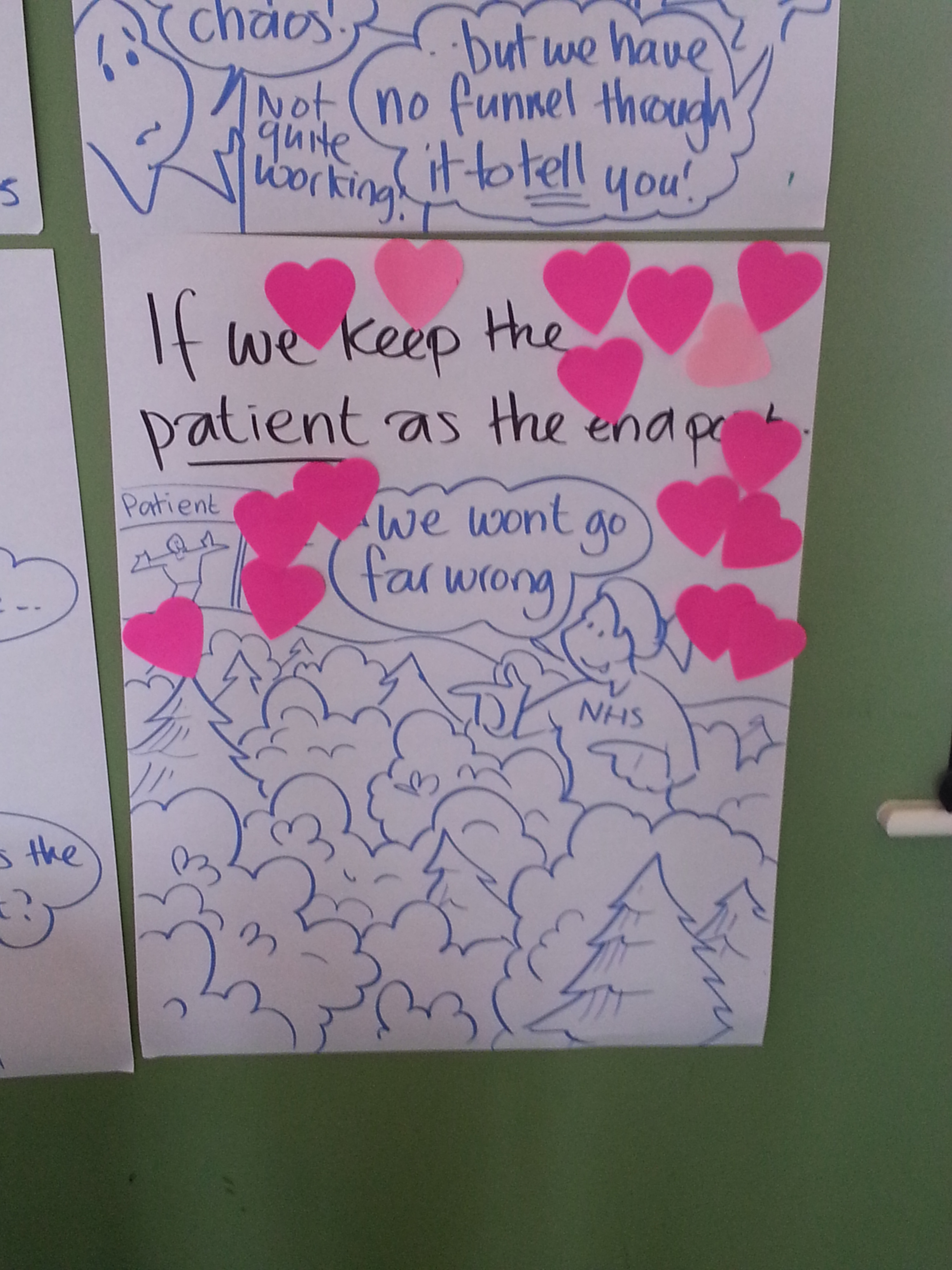
This picture was a favourite with participants - by Graham Ogilvie
This picture was a favourite with participants – by Graham Ogilvie

Last week I enjoyed working alongside Graham Ogilvie at a one-day event with leaders in the NHS to reflect on their learning from some of the NHS’s core leadership programmes.  Graham is someone whose career is almost bound to raise eyebrows.  (“How on earth did you come to do that?”)  Graham has made a great career out of turning the verbal into the pictorial – taking the key messages from training events, conferences and more and turning them into cartoons.  It seems unlikely that anybody ever said to him, “Son, what you need to do with your career is this…”

Always interesting to me, it happens that I’ve been reflecting on career directions quite intensely recently.  One client organisation has asked me to put together an outline programme to help members to identify next steps in their career.  Coaching clients are raising questions, from “What can I do to move towards greater fulfilment and peace of mind?” to “How can I create fulfilment in my forthcoming retirement and give something back?”  (Yes, the age-range of my clients is broad).  Another client has asked me to help create clarity for leaders across the organisation about their forward career paths.  As the French say, “Jamais deux sans trois.”

Struggling to identify next steps in your career?

Graham, and others like him, epitomises an aspiration many people have – most of us want to find fulfilment in our lives and careers.  Somehow, he’s managed to create a job for which there was no Job Description and to turn it into a career that is fun, profitable and fulfilling.  But if you’re unsure of your own next steps, you know it’s not always so easy.  Sometimes, it’s hard to see which way to go.

Perhaps you have an expensive education in Speciality X but are finding that jobs are scarce in your field.  Or perhaps you’ve been successful so far but don’t much like the speciality you’ve chosen.  Or you face stark choices and don’t know which way to go.

Perhaps you’ve achieved some – all, even – of the goals you set yourself a few years ago.  The trouble is, you’re not having as much fun as you thought you would.  Or you don’t know where to go next.

Maybe you’re loving what you’re doing and still, you face a choice.  Do you carry on as the “person who does” or step into the unknown territory of leadership?  Perhaps you’re already in a leadership role but something’s not working for you or you’re wondering “What next?”

Perhaps your greatest joy is on the side.  Perhaps it comes from the project you are involved in at work rather from the areas of your work that your employer is most concerned to monitor, manage and reward.  Perhaps it really is on the side – coming from a hobby that no-one pays you for.

Perhaps you’re one of the many people who have been affected by our deep global recession… young and unable to practice the profession you trained for, mid career and finding your way forward after redundancy, ambitious and wanting to catch up after setbacks.

The thing is, you know that you’re not emotionally fulfilled and you know you have more to give.  At the same time, you don’t know where to go next.

Life at Malt House Farm

You may not know that I grew up on a farm.  My father started farming in the 1920s and my mother met him when she came to Berkshire to work.  They married in 1957 and farmed until they retired in 1980.  I have a photo of my mother, at hay-making time, which hangs on my office wall.  The stray bits of hay in her hair are a reminder of a time of year we all enjoyed and I also notice a certain steely glint in my mother’s eyes which remains to this day.

I’ve noticed how many of my clients have views about their careers which reflect the views and experience of past generations of parents and grandparents.  Things like “I need to get a steady job that will provide for me and my family until I retire”, “If I don’t get on the right ladder at the beginning of my career I won’t be successful” and “I need to have clear career goals from the beginning of my career in order to make the right choices in the here and now.”  There are even some more recent concerns that can go unseen because they are so widely held.  “I need to show I can earn at least as much as my (partner, peers, parents etc.) otherwise people will think less of me”, for example, and “I am what I do – I need to do something impressive if I want people to like me or admire me.”

The thing is, these beliefs – and others like them – come from our need to feel safe and secure and yet, at the same time, they fuel the very anxieties we seek to avoid.  They make us wonder if we’re on the right ladder, and worry that if we’re not, we’ve missed our chance to have a fulfilling career.  They make us try to plan for a future which may be radically different from anything we can imagine right now – and worry when we don’t have the answers.  They make us make job choices to meet needs we can meet more easily in different ways;  which may even have been met already if we only dare to notice how much we are already loved and admired.

In writing this posting I want to bring care to the parts of us that seek security, acceptance and more.  These needs are both primal and primitive.  We are here because we have given priority to our need for safety and because we continue to do so.  What’s more, career or no career, each one of us has a need for love and acceptance.  Many people, early in their career, focus on adapting to the roles they find themselves in in order to secure a living and to achieve some measure of acceptance from their employer.

But this is only part of what we desire.

As much as we’re hard-wired to worry about our most fundamental needs for security, nourishment and more, we also have needs for fulfilment, for self-expression, to make a difference by what we do.  If we listen only to our worries, we may feel empty and unfulfilled.  Over time, our lack of fulfilment or our desire for something more motivates us to seek new avenues.

Your perfect career is about who you are

As much as we spend our education acquiring knowledge and skills, our success at work is driven by far more than any book learning.

At work, employers are often concerned with our behaviour – do we demonstrate the behaviours we need to be successful in our current job?  A great deal of research has shown that whilst our knowledge and technical skills are important, especially early in our career, there’s a great deal more that fuels our behaviour.

More fundamentally, our behaviours reflect a set of values that we hold about what’s important to us.  They reflect all sorts of hidden (and sometimes limiting) beliefs – what some thinkers call our “world view”.  They reflect our sense of who we are and what we’re here to do – our identity and purpose.

There is bad news.

Sometimes, for example, we don’t know what values we hold and this makes it hard to seek out opportunities which really meet our need for fulfilment.  Sometimes we have a sense of identity which is frozen in time and out of kilter with who we really are.  Sometimes we are held back by limiting beliefs which remain out of view.

There is good news, too.

The good news is that we are most likely to be successful in our careers by being ourselves.  The good news is that the more we understand ourselves – our underlying values, our natural strengths, our core purpose – the more we can seek out and move towards opportunities that fulfil us.  These are jobs in which, moreover, we find greater ease.

The good news is, too, that we get to explore who we are and examine old beliefs about ourselves and about the world at large and, in doing so, we increase the likelihood that we will find both career success and personal fulfilment.

Following your bliss

Joseph Campbell, author of The Power of Myth and The Hero with a Thousand Faces calls this process “following your bliss”.  I shared this phrase with Graham Ogilvie when we met last week, because it seemed to me that his description of his personal journey was a perfect example.  Graham told me that, each time he faced a choice, he chose the option that was most appealing to him at the time.

In truth, as much as many people tell their children to choose wisely, past generations are littered with people whose lives have been touched be serendipity, synchronicity and more… and it all worked out in the end.

My father, for example, became a farmer because he was told, for the sake of his health, to leave his office job and to work outside.  He was already lodging at Malt House Farm and was able to take up a job because his friend Harry, the landlady’s nephew, wanted to leave farming.  Years later my mother became a farmer because she fell in love.

Perhaps you have stories, too, of people of whom you could ask, “How did they get from there to here?”  If you do, please share them using the comment box below so that they can be an inspiration for us all.

And as I close, I want to ask you, what choices are beckoning you at this time?  And how is your heart responding?  Your head?  Your gut?

Taking disciplinary action? Don’t take the soft option

If you think that to bring empathy to your disciplinary process is to take the soft option, I want to show just how badly a lack of empathy can get you into trouble and invite you to bring both empathy and compassion when you exercise discipline – for yourself and for those you lead.

Is your heart sinking at the prospect of addressing some employee misdemeanour or incompetence?

It’s a rare leader who looks forward to a conversation with an employee about something that’s gone wrong.

You know the kind of thing.  Rules broken.  Poor performance.  Inappropriate behaviour.  Bad BO.  The list is long.

You know that something isn’t quite working.  You’ve taken time to monitor and observe.  Maybe you’ve asked others for the feedback – or received it whether you wanted to or not.

You’re concerned about the impact of your employee’s failings.  You can see the impact on the team, on your clients, maybe even on the reputation of your organisation.

Your heart is sinking.  You know it’s your job to have the conversation and you wish it weren’t.

When leaders get into a mess in taking disciplinary action

If you talk to the HR professionals in many organisations about times when things have gone wrong when it comes to exercising discipline – oh my!  They’ll roll their eyes!

They’ll tell you about the time they spent providing emotional support both to employees and to their managers.  Tea and tissues?  It may not be what they want to do and still, getting it wrong can leave everyone involved feeling emotionally exhausted and yearning for understanding.

They’ll tell you about the impact on employee morale.  Yes, there’s the morale of the two people most closely involved.  More than this, the impact of a poorly handled disciplinary process is rarely confined to the employee and his or her manager.  Team members provide emotional support.  Perhaps they get angry or upset or anxious for their own jobs.  The conversation that was designed to designed to address a particular issue stimulates all sorts of emotions for everyone involved.

Maybe the issue managers set out to address goes unresolved.  At best, the action taken just wasn’t effective.  At worst, it was so badly off kilter that the lawyers need to be brought in as well as HR to sort out the mess.  All this takes time and attention away from the broken rule, the poor performance, the inappropriate behaviour, the bad BO.   What’s more, you have a whole new set of issues to address.

What is it that goes so badly wrong?

Usually, colleagues in the HR department will point to just two things:

Firstly, they’ll tell you how they tried to give advice to the person concerned and how it wasn’t followed.  Often the advice is about an organisation’s disciplinary process.  If it’s well-designed it will help line managers both to meet legal requirements and to ensure that an employee feels that he or she has been handled fairly and even given support.

They may not say it, but behind the good advice about process there is often a second issue lurking undetected.  The issue?  A lack of empathy.

Creating a rehabilitation culture in our criminal institutions

Did I say criminal?  Yes, I did.

A few years ago, I was deeply touched when Dominic Barter told a story of some restorative justice work he had done in Brazil.  A baker, whose son had been shot and killed in the bakery, was so moved when he learnt of the killer’s experience of poverty and his intention only to steal a loaf of bread that he gave the killer a job as a way of making something good from the original crime.  This was possible because the baker was able to transcend his grief at the loss of his son and bring deep empathy and understanding for the man who had killed him.

More recently, the RSA advertised a talk by leading criminologist Professor Shadd Maruna entitled Creating a Rehabilitation Culture.  This is what they said about the talk on their website:

Numerous criminal justice observers have argued that offender rehabilitation does not come in a ‘programme’.

Although targeted treatment interventions can be helpful in promoting desistance from crime, these projects are too often undermined by an overarching punitive culture that stigmatises and labels the individuals that programmes are meant to be ‘correcting’.

In case you haven’t made the link yet, this is what – too often – goes wrong when leaders seek to address issues in the workplace.  A lack of empathy, coupled with labelling the very person from whom a leader wants change, sets the leader up for the hardest possible ride.  The downward spiral has begun.

Finding a place of empathy when taking disciplinary action

If you’re facing the prospect of holding a disciplinary conversation with a member of your staff, finding a place of empathy for him or her is an important part of your preparation.  So is finding a place of empathy for yourself.  Here two things you can do to get you started:

Firstly, take time to find a place of empathy for yourself.  Find a quiet place where you can be undisturbed.  Take a few moments to notice the thoughts and emotions you have when you think about this person and what they have done and without censoring yourself.  Pay particular attention to your emotions and get curious about what sits behind your feelings.  As a leader, you are best placed to handle a disciplinary conversation well when you are open to and accept the challenges this brings you and give time and space for your needs.

Take time, too, to find a place of empathy for the person with whom you need to talk.  Take a few moments to get curious.  What positive intentions does he or she bring, even when doing the things that aren’t working for you?  What hopes might he or she have for a conversation with you – whether or not s/he’s done something “wrong”?  (Some people ask themselves how they would like someone they love to be treated as a way of putting themselves in the shoes of their direct report).

Discipline yes – but not crime and punishment

Although targeted treatment interventions can be helpful in promoting desistance from crime, these projects are too often undermined by an overarching punitive culture that stigmatises and labels the individuals that programmes are meant to be ‘correcting’.

Targeted at the UK’s criminal justice system, I find these words from the RSA’s programme have a broader application.  How many of us are drawn to think ill of the person with whom we need to hold a disciplinary conversation – to stigmatise or label them?  And where else does this attitude show up in our life – with our spouse, perhaps, parents, children…  I’d like to say that it’s easy to avoid this place of judgement towards self or others and yet, in our culture, it isn’t.  It’s so easy to protect ourselves by putting others in the wrong.

It’s easy to start in this place of judgement and yet, it does not create ease.  Our judgement – of self and others – stimulates a great deal of resistance and this, in turn, creates conflict.  With empathy, we can put our concerns on the table freely and openly whilst building or maintaining our relationship with those we lead.  We can insist on certain standards in the workplace without putting people in the wrong.

Equally, with empathy, we can forgive ourselves – or each other – when our initial disciplinary conversation does not go according to plan.  And when we ask ourselves “where do I go from here?” empathy can help us to find a way forward which maximises the positive outcomes for everyone – yes, everyone – involved.

Office politics – a force for good

Really?  You must be joking!

If this is your response to office politics, this posting is for you.

If you loathe office politics, you’re not alone

Listen, I have to put my hand up, too – I’m not a great fan of office politics.

You know the kind of thing…

…You watch colleagues get promoted ahead of you who are all show and no substance.  You know how they do it.  You watch them cosy up to the people who make the decisions and you can see that it works.  Maybe you even want your own (overdue) promotion… but you can’t bring yourself to follow suit.

…You’ve seen how your colleagues lay claim to successes when the credit really should go to someone else.  You know that a radical game-changing idea has come from someone who has gone without acknowledgement or someone else has taken all the credit for the hard slog it took to bring an important project to a fruitful conclusion.  And still they take the credit.

…You watch your colleagues promote an idea around the business and you know – you just know – that the real agenda is tucked away from sight.  The lack of honesty on the part of the person doing the promoting, the naivety of your most senior colleagues in not seeing through the propaganda – well, you’re finding it hard to swallow.

…Maybe you even listen to one of your colleague’s self propaganda and you wonder, “Does he really believe his description of himself or is it just the story he’s trying to sell around the business?”  You can’t believe how many people are taken in when you find it so easy to see the huge gap between the way your colleague describes himself and the way he behaves in practice.

You’re struggling with office politics, which fill you with loathing.  At the same time, you can see just how much politics plays a role in the every day life of your organisation.

A political epiphany

Over the years, and despite my own inherent suspicion of the office politicians, I’ve had the opportunity to observe how the ability to navigate office politics is an important skill as a leader in an organisation.  If you already have this skill, you probably haven’t read this far.  If you don’t have this skill, or you’re sceptical about the idea that politics can be a force for good, you probably need a bit of convincing.  For this reason, I want to share with you an example of one person’s “political epiphany” – it’s a simple story of one person who discovered that, after all, politics can be a force for good.

Sally (let’s call her Sally) was a talented graduate entrant in her company who liked to play with a straight bat.  As she rose to a junior management position, she became increasingly aware that she was working to a director who was poorly equipped for the role and she felt frustrated that her company did not seem to be addressing the issue.  She raised the issue with her colleagues in HR but got no joy and, after a while, realised that – whatever she thought of her senior management – she was beginning to get a reputation as a whinger.

Sally could have let the issue go.  However, she was particularly concerned about the impact of her director’s inadequacies on a project she felt really passionate about.  She decided to take the issue to her mentor.  Her mentor knew her preference for playing with a straight bat and asked her, “What’s most important to you?  Is it the inadequacies of your director and the failure of senior management to address them?  Or is it finding ways to make progress on your project?”  Initially, Sally found it hard to separate the two.

In her discussion with her mentor, Sally began to realise that there were, indeed, two forces at play.  On the one hand, she found it hard to accept what looked like inaction on the part of senior management who were failing to address something that was clearly a problem.  Her own values of openness and honesty were such that she struggled to accept the possibility that senior management preferred to work their way round the problem rather than to name it honestly.  On the other hand, she also recognised that it was the impact on the project that was most frustrating for her – at least for the time being.  With the help of her mentor, she began to see that whilst she had limited scope to address the short-comings of senior management, there were things she could do to move the project forward – if only she were more willing to play the political game.

In service of a larger cause

Years later, Sally pointed to this experience as the one that made her a total convert to office politics.

Because she was passionate about her project, she started to experience a real sense of achievement each time she did something to successfully circumnavigate the limitations of her line manager.  What’s more, because she realised she had gained the reputation for whingeing, she started to look for ways forward that could cause no offence.  She didn’t want anyone to think that the progress on her project was being achieved by side-lining her boss.

One thing made it possible for Sally to put aside her loathing of office politics – her passion for her project and what she knew it could do for her organisation.  With the help of her mentor, she began to see how she could use a political approach to move the project forward.  She began to see how, sometimes, you can’t achieve the things you feel most passionate about without becoming familiar with the political landscape, accepting it – and starting to find ways round the obstacles that are in your way.

Once she had this insight, Sally became a master politician – and started to enjoy it.  Having realised that she could use her political savvy in service of those things she found most worthwhile, she started to apply her creative thinking to this area of her work.

Finding your political epiphany

If you think I’m going to tell you how to navigate the politics of your office – or family, or local Am Dram society, whatever…  well, I’m about to disappoint you.  Instead, I’m going to invite you to go make yourself a cup of tea, or coffee, find a quite corner for 5 minutes and ask yourself this:

What are the things that really matter to you?  What areas of your life do you feel most passionate about?  And which of these are so important to you that you’re willing to let go of your revulsion for office politics and your views about how things ought to be and embrace things the way they are – in order to find ways to move towards the outcomes you most desire?

You may find your motivation at work – but you may not.  Perhaps there’s something away from your work place that you’re really fired up about right now.  It doesn’t matter where your political epiphany happens.  It just matters that it does.

Why?  Your political epiphany helps you to become much more effective in achieving results with ease.  What’s more, your political epiphany helps you to realise what matters most to you.

Whether you’ve had your political epiphany years ago or haven’t had it yet I’d love to read your comments on this subject via the comment box below.

Bringing care to times of conflict

In recent months I have found myself in the midst of a disagreement – a rather long, drawn out affair which started just when I was recovering from the experience of supporting a friend in crisis.

The experience has reminded me just how hard it can be to navigate conflict in the workplace, so that I’m going to try to talk about conflict today.

It all started with…

Have you ever found yourself, quite unexpectedly, in a situation of conflict at work?

Perhaps you did something, in good faith, which stimulated anxiety or anger in one of your colleagues.  If you’re lucky, the colleague is someone you know or someone who is skilled in handling his or her emotions constructively.  Perhaps, though, your colleague is someone you don’t know, so that you don’t have a track record of mutual respect to fall back on.  Or maybe he or she has a different track record – as someone who is prone to unexpected explosions, to trying to put people “in their place”, to… you get to write the list.

There are any number of things about your colleague’s behaviour that make the situation worse.  Firstly, in the midst of an explosion – maybe a full on amygdala hijack – your colleague absolutely believes his or her own story.  It’s not just that he or she is concerned that something might happen as a result of what you’ve done.  No.  The action you’ve taken is bound to lead to x, y, z…  If you’re not careful you, too, are at risk of getting swept up in a line of thinking which has not yet been closely examined.  Maybe, too, your colleague lacks the sense of perspective, after the fact, to examine his or her own thinking…  the case against you is proven before the facts have been gathered.  He or she may even do his very best to make sure that facts are obscured or kept out of view.

If you’re deeply unlucky, you may find that the person who is treating you in this way has a long history of similar outbursts which have, over time, been unchallenged.  Unless your organisation has a firm anti-bullying policy or a culture which is quick to address these behaviours in general or the behaviour of your particular colleague, they will continue.  What’s more, your colleague’s sense of righteousness will grow and, with it, the post-toddler temper tantrums.  In the mind of your colleague, you deserve to be treated in this way  – he or she is right, after all.

Hey, in really tough cases, your colleague may even be the boss.  Your boss.  Or the ultimate boss – the boss of all bosses, the CEO.

What’s more, whilst your colleague may not be skilled in handling his or her skills constructively, he does have other skills…

…He’s highly skilled in making unilateral decisions with no thought whatsoever for the impact on you…

…She’s hard to pin down.  When you ask a clear question or make a clear request, she has a way of ignoring them as if you had never asked…

…He’s highly selective when it comes to the facts, ignoring some, putting others forward repeatedly and vociferously, withholding some… hey!  Even distorting a few…

…She’s really strong on holding you to account for any mistakes (real or imagined) whilst being, of course, totally blameless…

What makes it hard?  Well, you, too, are human and may struggle with the emotional roller coaster that your conversations or correspondence stimulates in you – from fear to rage, anger to anxiety.  You may, even, have your own sense of self righteousness.  And if your colleague is also the boss, maybe even the ultimate boss, you may fear that your only options are to roll over and take the punches or to leave your job.

Tempting strategies that don’t hit the mark

Reflecting on my own experience in recent weeks, I’ve noticed that it’s tempting to follow certain routes.  They’re tempting – they really are tempting!

Outrage, disbelief and feeling hard done by.  Did that really just happen?!  I can’t believe that anyone would do that!  Don’t get me wrong, you feel what you feel.  The person did what they did.  It may well have been a crazy thing to do… in your map of the world.  However, nothing changes as a result of you feeling the outrage or knowing that every rule in the book has been broken – whether the real book of your organisation’s rules and procedures or the metaphorical book of what people do who are emotionally intelligent and effective in their roles.

Trying to prove you’re right.  When your sense of injustice is strong, the desire to put your case can be strong, as can your yearning to be heard and understood.  There is, though, no guarantee that you will be.  In the midst of panic or blind rage, your colleague is not in possession of the facts.  No, he or she can only relate to his own fears – the inner story of his or her imagination.  After the blind rage is over, he may still stick to the story he created when this whole thing kicked off.  Holding out for a fair hearing?  It may never happen.

Relying on policy or procedure.  You have a procedure in place that covers this kind of thing?  Maybe a grievance procedure or an anti-bullying procedure.  By all means use it and still, it may not work.  Especially if your colleague has a role in carrying out the procedure, there’s a risk that it may not be followed or that it will be followed in ways which simply confirm your colleague’s view of you.

Relying on senior management.  I’m sorry to disappoint you.  It’s possible that bringing the matter to the attention of the very people who ought to be managing your colleague will help.  It’s possible, too, that your colleagues are as ground down as you are in the battle to uphold company policy, dignity (yours, theirs), good sense and whatever else you’re longing for.

Jumping ship.  It’s possible to just walk.  To find another job.  To move.  To say “Fuck you!”  Possible. Tempting.  There is, though, the risk that you are the loser when you choose to walk away.  It was your job – and you lost it.  How unjust was that!

Resorting to anger and hatred.  Don’t get me wrong, this strategy can be as juicy as they come.  You may even find all sorts of people lining up to join in.  Think his behaviour is outrageous?  So do I!  Wonder if she’s got issues from childhood?  What other explanation can there be?!  Think he ought to know better at his level of seniority?  For sure!  But this, though it may give you some relief, will not, ultimately help you to find peace.

Care changes everything

These strategies do not work and yet, in a way, they do… provided you can bring the quality of care to your situation as it unfolds.

In my own experience, I noticed how, from the beginning, I was able to notice my needs… a longing to be heard and understood, a longing for courtesy and consideration, a deep desire for the kind of collaborative approach which might address real concerns whilst leaving everybody’s dignity intact.  What I noticed – what I notice – is how, over time, touching base with my needs has brought a sense of peace, even when they are far from being met.  Even as I write, the very act of naming my needs is bringing a quality of tenderness to my heart.

As much as I have been making a stand for my own needs to be met, I know this is not enough.  At times, throughout this process, I have taken time to put myself in the shoes of everyone else involved.  I may think that my colleague has taken a hammer to crack a nut (and, what’s more, a nut that was already open).  Still, I recognise how much this has added to his or her workload and at a time when he or she is at full stretch.  I may think that a wider group of people should feel uncomfortable and step up in the role each one has taken on and, still, I can see how hard it is to address the very behaviours with which I, too, struggle.

With care, I have found a sense of peace and liberation.  It’s not that things have gone the way I hoped – not at all.  Still, at each point in the process, I have learnt more about the personalities involved.  That step didn’t give me the information I asked for, even though, clearly, I’ve made a legitimate request.  Still, I’ve taken action to care for my needs.  I’ve taken care to acknowledge the needs of others.  Over time, I’ve come to understand the issues.  I’ve come to know what’s mine – and what’s not mine.

And what are friends for?

I could not finish this posting without adding that friends, too, have played an important role.  In the moments when I’ve thought “has this really happened?”and “am I mad?” I have called on an inner circle of supportive friends.  They have brought humour to the situation.  They have confirmed that, yes, this is way off piste.  They have helped me to keep things simple as I work out each step of the way.  Above all, they have brought care.

It is this care that has made things all right, no matter which way things go.


Who’s managing who? Setting clear boundaries with your staff

In the classic way of London buses, I have been enjoying a flurry of clients recently who are grappling with the same issue.  In their relationship with their direct reports, who’s managing who?

Recently, for example, I found myself talking with a young manager about a member of his team.  Much older than him and more experienced in managing others, this particular member of staff would flare up with irritation from time to time.  Her young and inexperienced manager would watch this mini amygdala hijack unfold before his eyes and wonder quite how to respond.  How could he manage her in a way which left her feeling happy and which, at the same time, ensured she got the job done?

The thing is, over time, he realised that he had gone so far out of his way in his attempts to make her feel comfortable that his own needs of her, as a member of his team, were not being met.  His growing concern was this – have I let her become my boss?

When the tail starts wagging the dog

This young manager is not alone.  Maybe you have your own experience of managing someone who is not easily pleased.

Let’s be clear.  You know that you’re responsible for this thing called staff engagement.  Maybe you even have the annual survey to prove it.  You really get the message – your staff have a vital contribution to make to the success of your organisation and the way you choose to manage team members has a significant impact on their well-being and the quality of their contribution.  This is something you whole-heartedly buy into and endorse.

With luck, experience, skill and even the results of a few psychometric tests, you know that different members of your team have different styles and preferences.  You also recognise that each member of your team has a different level of experience in his or her job and maybe different aspirations.  You recognise you need to tailor your approach to get the best out of each member of your team.

Somewhere along the line, though, you’ve lost sight of the boundary between managing members of your team and letting them dictate to you.  Probably it happened slowly, subtly.  You look back and think, when did I agree to a slight change in John’s working hours?  I didn’t.  How did I let Mia define her role and responsibilities in ways which don’t work for me?  I didn’t.  When did I choose to make it my job to save Gina from herself – from the difficult emotions she experiences when she realises that her career didn’t turn out the way she hoped?  I don’t even know.

chez Nesbit

Over the years, I’ve had people live with me – in my flat in Lee High Road and, more recently, here in Albion Way.  First, I bought the flat with my friend Jenny and we lived together as co-owners of the home.  Cousin James lived with me for a while when he first came to London.  Cousin Mat lived with me when she did an internship for a while.  Then Nancy joined me… the list goes on.  Perhaps the briefest of stays was by a lovely German man and his son when they wanted to visit London.  They were introduced to me in the “friend of a friend” way that sometimes happens in life.  The longest stay was by a member of the family who lived with me for almost three and a half years before moving out just recently.  There’s nothing like living together to teach you a bit about boundaries.

I laugh when I think of my time sharing with Jenny as two young women early in our careers.  How could we be less suited?  I say this because Jenny has always had a personal temperature gauge which is permanently on “high” – I have photos of her in Norway in the snow in a summer skirt and with bare legs.  When Jenny moved out, the first thing I did was to install central heating.  Notwithstanding, I remember our time together as easy and comfortable and lots of fun.

Over time, welcoming people into my home has taught me a few things about what matters to me in my home.  It’s also taught me that what matters to me is not always important to others who live in the house.  Want to leave plates around for days on end?  This isn’t the home for you.  Not worried about how clean the bathroom is?  That doesn’t really work for me.

In truth, I’ve had to learn a few things about my own personal quirks – and own that, in my own home, I need to find people who can accommodate them.  Perhaps it is a bit OTT (OCD, even) but it matters to me that the soup spoons and dessert spoons are put away in their separate spaces in the top drawer in the kitchen.  And (please, don’t tell) I often reorganise the contents of the dishwasher in a way which meets my need for order as much as my desire to get as much in as possible.

The fundamental rule of the house

Over time, I’ve developed an agreement which sets out the terms on which lodgers live in the house.  Every time someone leaves I ask myself “what have I learnt that I want to incorporate into the agreement?”  Yes, there are “house rules”.  The most fundamental rule in the house, though, is that living together has to work for everyone.  My agreement says:

Successful sharing of the house will reflect our sensitivity to each others’ needs and our ability to speak openly about our needs and to find ways to meet them which work for every member of the household.  As part of your tenancy agreement, you agree to make time to talk about what’s working and what adjustments might be needed.

Now, I must concede, that in the early days of welcoming visitors, I knew this and yet… I didn’t.  I was like the young manager bending myself in knots trying to meet the needs of people living with me… at the expense of my own.

It’s taken time for me to realise that, as the home owner, I am the one constant in this house.  I need to be clear in my own heart about what does and doesn’t work for me because, ultimately, I need to find people who can feel comfortable living under my house rules so that I, too, can be comfortable.

A leader’s “house rules”

In truth, a leader is not so very different from a landlady.  In your role as a leader, you need to know what your own house rules are – and why.

To work out your own house rules is not so much a “once in a lifetime” thing as an ongoing dance of self enquiry.  Perhaps, for example, you are managing someone who doesn’t like the level of supervision you want to give.  Perhaps, on close examination, you’ll find you are under-estimating his or her experience and capability in the role.  Perhaps you’ll find that your own need for detail is such that you are breathing down the necks of even the most competent of your staff members.  Over time, though, you need to work out what level of information you need from your staff to retain accountability for their work.  This is just one area in which you need to develop your own house rules.

If you’re struggling with boundaries with your staff, why not take a few minutes now to ask yourself what you expect of members of your team – no matter what?  And if you find that you’re struggling to maintain clear boundaries be gentle with yourself.  Just notice what you want to move towards – what rules you want to have in place – and let go of any judgements you may have about the fact that you have allowed something to go on for so long which, so clearly, isn’t working for you or the business.


It can be hard to say to a tenant, “if that’s what you want, this is no longer the house for you.”  It can be just as hard to say to a member of your team, “if this is what you want, you need to start thinking about finding another job.”

But you can’t begin to have the conversation if you don’t have clarity in your own mind about your own house rules.

Struggling with the way things are? Time to notice what is

I’m feeling angry.

Sometimes, life brings us the very lessons we most want to teach others …again and again and again.  It’s the Ground Hog day of the teacher’s own learning.  We get to take the learning with humility or we get to pretend.

Our students always find us out.

So, with timely synchronicity, this week I received the response to an appeal I put forward a few weeks ago as a reminder of just how hard it can be to notice how things are, accept them, and move on from there.  There was nothing in the response to my appeal that gave me any comfort that justice (natural or otherwise) has been done.

The challenge of accepting what is

Maybe you’re familiar with the challenge of accepting what is.

You know your boss has had all sorts of training that suggests that seeing the best in people or working collaboratively (or… or… or…) is more likely to get good results and still, your boss is managing you in ways which leave you feeling your work isn’t appreciated, that you’re liable to be punished for breaching rules you didn’t know existed (or, worse still, for breaching rules that you know don’t exist), that the give is all coming from you and the take is all coming from your boss.  Every time you think about your boss you chafe against an approach which ought to be different.

You think the way your (insert brother, sister, spouse, mother, father, friend, colleague, other) is behaving right now is outrageous.  You can dress up the language (‘ineffective’, ‘unhelpful’, ‘inappropriate’ or whatever) but, fundamentally, you’re finding it heard to accept somebody else’s choices and you think they should be choosing something different.  You feel angry, upset, disappointed, frustrated…

You’re managing a member of staff who, by now, should have mastered a certain skill or who lacks motivation.  Hey!  Worse still, maybe you’re managing a whole team of people who lack the motivation or the polish or the commitment you expect to see in your team.  You can’t believe your team member(s) could be so unprofessional.  Maybe, even, you can’t believe your predecessor in the job could have let things go on so long the way they are.

At home, you’ve asked your son – repeatedly – to tidy up his room and he keeps on saying yes… and doing no.  You can’t believe he’s being so uncooperative and still expecting you to (insert cook meals, pay for his violin classes, drive him from A to B, give out copious amounts of hugs and emotional support, other) as if everything’s working perfectly.

Whatever the reason, you’re struggling to accept something that isn’t the way you’d like it to be – often, with good reason.

Living with Radio 4

Now, I want to take a moment to talk about my life long relationship with BBC Radio Four.

Growing up, the radio was always on in the kitchen at Malt House Farm.  At least, at some stage the “wireless” was always on until it became a radio.  And it was always tuned to BBC Radio Four.  Woman’s Hour, Alistair Cooke’s Letter From America… The Archers was on at 7pm in the evening, again at 2pm the next day and again on Sunday mornings.  I marvel now at how I was able to do my homework to the background noise of BBC Radio Four.

More recently, though, I have had periods of abstinence.  In particular, I have chosen not to wake up to the theme of “who’s to blame?” which seems to prevail on the Today programme.  Does there always need to be someone to blame?

I mention this because it seems to me that the idea that something or someone should be different is culturally sanctioned in my own corner of the world.  So if, like me, you’re chafing right now at something or someone that really isn’t working for you, you’re only doing something that is widely accepted as an okay way to go about your life.

How though, might this play out over time?

In the land of “things ought to be different”

I remember hearing of one company director who was fundamentally opposed to the strategic direction his company was taking and campaigned vociferously to reverse a decision to go in a particular direction.  When his arguments fell on deaf ears, he shouted a little louder and a little louder, without ever stopping to take stock.  You only had to look at the composition of the board to realise that the decision was not going to change.  Meantime, he gained a reputation for being difficult to work with and lost the good will of his peers.

And what about the leader who pursued her childhood dream and achieved it, striving to prove her parents wrong (“Is that really you, dear?”) by working towards and gaining a senior leadership role.  On a leadership course, feedback from her staff suggested that she had a very limited range of leadership styles and that levels of satisfaction amongst her team members were low.  She felt angry and resentful – after all that she’d done for them!  Still, twenty years into her career, she was still trying to prove her parents wrong.

Recently a friend of mine who is a senior employment lawyer pointed to some of the injustices that staff face in the hands of their employers.  The trouble is, she said, even when companies are clearly in breach of the law, it’s hard to bring a case and expect to continue to work in the organisation that has got it wrong.  And there are other costs, too… the emotional toll, the time, the money, the risk to your relationships with loved ones as they worry about you at first and then get irritated with you for what you’ve put them through over time.

Noticing what is

Some of the most effective leaders have an ability to notice what is.

The company director who can survey the board and and get under the rhetoric of his or her colleagues to notice what the Finance Director gets most excited about or to identify the tiny incongruities between what the CEO says and what he or she does in practice, has information that can inform decisions and lead to a more effective approach.  Can’t get the FD on board?  Let me tell him about the impact this will have on profit margins and how… since this is clearly what is most important to him.  Sometimes, too, noticing that you have some fundamental differences with your colleagues is an invitation to notice what’s most important to you and to consider what changes you can make that will lead you towards a life that is aligned to your values.

If you’re unhappy in your job, noticing that you have achieved your childhood dream but that this has not given you the joy and satisfaction you thought it would, or rid you of your concern that your parents might not think well of you, or even given you staff who are happy and fulfilled in their work or performing well… this, too, opens up the opportunity to notice the yearnings of your heart.  What is it you really want?  Your parents’ approval?  And what does that tell you about what, with or without any particular response from your parents, you really want?  Acceptance… understanding… love…?

The person who is considering taking his or her employing organisation to court may indeed have been  wronged by his or her manager, company or organisation.  The law may have been broken.  His or her manager may indeed have broken company rules.  Natural justice may not have been served.  These are, though, things that have happened and cannot be changed.  For this person, too, there some fundamental needs have not been met… for understanding, consideration, respect…  to recognise these needs is, in itself, to honour them.  More than this, taking time to notice these needs and all the emotion that comes with a situation in which they have not been met or have even been violated, can guide an employee in what to look for when making requests of a current manager or seeking to work with a new employer.

Noticing what is is about being curious about other people – how does he tick?  What are her chief concerns?  It’s about noticing the politics of an organisation.  What are the official rules?  The culture?  What happens in practice?  Noticing what is is also about being curious about ourselves.  What thoughts are we having?  What emotions?  What is happening in our body?  Noticing, too, is about being curious about the information that we don’t yet have.  What understanding do team members have of the job they are expected to do?  Do they have clear job descriptions?  When were they last updated?  What about their performance reviews – what did their line manager say?  Each question opens up new avenues of enquiry and takes us from the world of assumption.  We may not like the information that emerges and still, we are more informed.

Sometimes, it starts with the emotion

I wonder if there’s any area in which you find yourself thinking that things ought to be different.  If there is, I invite you to notice…

…What is it that you feel so strongly about?  What do you feel?

…What thoughts are you having about the person or situation you’re struggling with?

…What do you know?  What do you not yet know?

…What can you do?  What is beyond your control or influence?

Yesterday, I tried hard to move quickly beyond the anger I feel about my own experiences in current months… and I did feel angry and upset.

It seemed important to notice what I know and what I don’t know… to find out who chaired the appeal, for example, who was at the meeting… and whether or not due process has been followed.  In the words of one friend –  “Aren’t appeals panels supposed to have discrete (i.e. no overlapping) membership with the original panel?”

Today I am just noticing my response to each new piece of information that comes my way.

I know I don’t want to feel angry for ever and still…

For now, that is how I feel.

Smoothing your path with compassionate collaboration

2013 was a challenging year for me personally and, if you’ve been reading my blog, you’ll know I made a somewhat chaotic start to 2014.  Exhausted, I have faced any number of new tests at a time when I feel my energies are depleted.

At work, in a state of exhaustion, I have faced inner struggle as my body tells me I need to rest and my inner Company Director tells me I need to crack on.  In need of space, I’ve found it hard to handle some of the challenges that face me personally and have had some difficult interactions with loved ones.

Only the other day, I missed signs that, triggered by something I’d said, a very dear friend was close to losing his temper with me – something he has never done in the quarter century we’ve known each other.

Conflict – a part of our human experience

It seems I am not alone.  Whether in the work place or at home, conflict – discord between ourselves and others or conflict within ourselves – is a regular part of the human experience.

Really?

In case you doubt it, I invite you to take a moment to notice what’s going on for you at this time.

Starting with yourself, are there any parts of you that are in conflict with each other?  Are you striving to move forward in some way and yet procrastinating?  Are there things on your “to do” list that, somehow, you are trying to avoid?  Have you set out your New Year vision for more exercise, healthier food, seeking a new job… and yet find that your actions belie your intentions.  If you recognise any example of this in your own life, you probably know just how much frustration, confusion, fear and other emotions you feel as part of this inner conflict.  It could even be that you feel strong emotions – fear, perhaps – about feeling those emotions.  You may even be trying hard to pretend that you’re “fine”.

Are you in conflict with anyone else, either in the way you are interacting with each other or in the way you are thinking of someone or feeling about them – be it a colleague (or colleagues), a friend, your partner or other family member?  Maybe you haven’t said anything and still, you’re fed up with the challenges you face when working with someone or some group of colleagues in your organisation.  Maybe you just can’t face going home once again to your teenage son’s sock pile, or to your partner’s admonitions that you’re late home – again.

Maybe you’ve even had a conversation with someone in the last ten days which was tense, angry, difficult.

On the path of most resistance

Recently, I was witness to an example of a conflict between a manager and one of his members of staff.

The manager, Greg, had found out that Jane, his staff member, had said no to a request from one of the organisation’s major clients.  It was her judgement that the company would struggle to meet the client’s requirements and, what’s more, to do so would be unprofitable.

The first she knew of any problems was when Greg sat her down and instructed her to make arrangements to meet the order – that day.  Jane knew that her team could not do that without letting down other clients and, what’s more, she was confused.  Why the instruction when she had a clear agreement with her boss to say no to any requests which would prove unprofitable to the organisation?  She asked for an explanation and was told Greg would get back to her following a meeting he was scheduled to attend.

This brief exchange left Jane feeling shocked and concerned.  She did, though, want to make clear that she wanted to find an outcome that worked for Greg and for her other clients.  She decided to drop him an e-mail to that effect and to let him know when she was available to talk about how they could fulfil existing orders and make room for this one.  She also included figures so that Greg could assess the profitability of this order.

She was shocked when Greg responded to say that he didn’t want to see her in the office for the rest of the week and would contact her by the end of the week to discuss any further disciplinary action.

Greg’s action put him squarely on the path of most resistance.  Rather than work with Jane, who had expressly told him she wanted to meet with him to find a way forward that worked for them both, he chose to work against her.

Fear – and the power of compassion

Greg didn’t know it, but he acted out of fear.

His great fear was that saying no to his largest client would damage a long-standing relationship.  And because it was Jane who had said no, when fear kicked in, he decided she was in the wrong and tried to exercise control.  Jane, who was more than willing to collaborate with Greg to find a way forward, was not happy to be suspended without good grounds.  Instead of holding a meeting to discuss a way forward that worked for everybody, Gregor’s action led to a lengthy process which consumed time and energy without actually working well for anybody.

In truth, we all have our inner Gregs and Janes.  The same kind of conflict occurs when we sponsor one part of ourselves at the expense of another.  Yes, we (that’s you and one part of you) think it’s a good idea to do do x – but goodness, how frustrating that one part of us is standing in the way!  What a stupid part!  It’s totally irrational!  Let’s push a little harder… push through…  The trouble is, whether we are dealing with inner conflict or conflict with some other person or group of people, this approach increases the struggle, the effort, the time needed to find an – often imperfect – way through.

In my work as a coach, I have found that struggle ends when compassionate collaboration starts.  In my conversations with clients, I invite them to notice what each part of them is really wanting.  As clients let go of judgement and start to really listen, they open up the possibility that parts of them that have been in conflict can begin to collaborate.  The question “which part of me is right?” gives way to a different question – “how can those different parts of me find ways to ensure all our needs are met?”

In her conversations with Greg, Jane recognised that he felt a great deal of fear.  She decided to stick up for her needs – but not at the expense of her manager’s.  She tried to understand his fears whilst also asking for revisions to the guidance he had given her previously, so that she could support him in managing the company’s relationship with a major client.  She also launched an appeal against the disciplinary action he had taken.

 Surprises on the road to ease

Sometimes, the choice to be present to everyone’s needs – to collaborate from a place of compassion – throws up solutions which surprise everyone concerned.  Jane could not know ahead of time, for example, whether her discussions with Greg would throw up new solutions or lead her to conclude that she didn’t want to work under such a regime.

In my own life, gaining clarity about my baseline requirements for working with one organisation recently led me to realise that yes, we want to work with each other but no, we don’t have the basis for any kind of agreement that would work for me.  I was surprised at just how relieved I felt as I leaned into this clarity and let go of trying to find a way to working together work.  I knew I would prefer to be on good terms than to work under an agreement that didn’t give me what I needed.

As I shared that, no, I wouldn’t work with this particular client, I let go of struggle and stepped into ease – and a new set of possibilities.  I was able to do this and to stay on good terms with a potential work partner because I gave full weight to my needs – and theirs.

It takes time and commitment to practise compassionate collaboration.  At the same time, to do so opens up ways to increase your effectiveness and create ease in your role as a leader and beyond.  I don’t want to understate the effort and discipline involved to develop in this area but I do want to offer you a first step:

I invite you to identify just one inner conflict or conflict with others and to get curious about what you need.  Get curious, too, about what others need.  And whether out loud or in your own heart start to say – to yourself, to others – “Hello.  I see you.  Your needs matter.”

On the path to greater ease – knowing what you want

Alice:  Would you please tell me which way I ought to go from here?

The Cheshire Cat:  That depends a good deal on where you want to get to

 Lewis Carroll

Alice in Wonderland

I’ve been thrilled to get back to work this month – coaching at the Sunday coaching clinic in Harley Street as well as a raft of feedback sessions for participants on a High Potential development programme and their managers.  This is work I love – getting beyond symptoms to help people to identify and address core issues.

It happens that, in coaching, the most fundamental question often addresses clients’ core issues.  The question?  What do you want?  The issue?  Do people know what they really want?  Of course, this question gets dressed up in many ways.  It also applies in many areas.  And still, it applies.

As a leader, the question of what you want can be extra tough.  Not only do you need to find your own direction but also you need to find everyone else’s.  Because, make no mistake, everyone is looking to you for direction.

The challenge of knowing what you want

In saying this, there’s something I want to make clear to you.  If you find it difficult to know what you want, if you feel confused or anxious, frustrated, lost or even at a loss, you’re not alone.

Recently, for example, one client told me how angry he has been feeling for months on end.  Angry.  Out of sorts.  And he didn’t know why.  His situation is not uncommon and may even have some resonance for you.  You find yourself feeling strong emotions which sometimes take you by surprise and yet you can’t connect them to anything you recognise.  You know you’re experiencing strong emotions but you don’t know what you really want.

Why is it so difficult to know what you want?

Over the years, I’ve discovered that there are all sorts of reasons why people struggle to know what they really want.  It’s not that they never know what they want (though it might be). Still, there are challenges we all face when we try to answer the question “What do you want?”  I wonder if any of these apply to you?

You’re supposed to be the leader, and yet, somehow, you’re not in charge.  Remember that “go for growth” agenda you were working towards?  Just as your team members were really starting to make progress you hit a major barrier.  In the old days, it was a new emphasis on quality or a failure by your colleagues in manufacturing to respond to demand.  More recently it was a major world recession.  Perhaps now, it’s a new CEO with a new agenda or, worse still, with no agenda, so that you find yourself in a holding pattern whilst you wait to hear about his or her conclusions from yet another major review.  Any which way, just as you felt you were really making progress you found you were moving in the wrong direction.

Perhaps, though, the issue is not a change in direction from the top.  No.  In a world which emphasises selflessness, commitment to your employing organisation or some other form of looking after somebody else’s needs, you’re struggling to muster a kind of inner permission to attend to your own needs – openly, honestly and fully.  You’re feeling out of sorts and you know things aren’t working for you but you don’t know what you really want.  Your career direction is unclear.  You’re struggling in your relationship with your boss, your spouse or even your children.  And because you don’t know what you want, you can’t begin to make progress in the right direction.

Maybe, though, the thing you wanted turns out not to be the panacea you thought it was.  You got the promotion you have been working towards for years and still, you’re not happy.  Your partner agreed to the move you discussed for weeks and weeks on end but you find that what should have been an exciting adventure is at the cost of a frosty silence between you which leaves you feeling angry, anxious or dismayed.  Your boss has responded to requests you made and has followed through to make things happen and still, somehow, you feel uncomfortable and you know your needs are not being met.  The bottom line is this:  you thought you knew what you wanted but you weren’t happy when you got it.

Sometimes, it’s hard to reach agreement with your colleagues about a way forward for your organisation.  Equally, at times, it’s your own inner team which is not pulling in the same direction.  Some part of you is pushing for action, progress, results… and yet, in practice, you are not taking some of the actions you know are key to success.  You shout louder at the part of you that is saying no to those actions… and meet more and more resistance.  You know what you want and feel frustrated and angry – with yourself.

As much as you want to know what you want, you also need compassion for the not knowing.

The world in your hands

At the turn of the millennium, I was heavily involved for a while in developing leadership in schools.  As a member of a team of people accrediting trainers on a national leadership programme for serving headteachers, I sometimes felt I was meeting a whole generation of headteachers.

Many of them were weighed down by the number of directives from the government of the day.  They felt that their autonomy was slowly being removed – they were increasingly responsible for results and yet they had less and less choice about how to achieve them.

Not every headteacher felt that way.  I remember one who told me that, faced with a new government white paper he would take a look at what was coming his way.  “We’re told we’re being consulted,” he said, “but you know that what’s in the paper will ultimately be implemented”.  His response?  To think about how he could use new developments in government policy and legislation to serve his own agenda.

It seems to me that whilst many of his colleagues carried the weight of the world on their shoulders, he carried the world in the palm of his hands.

What the headteacher knew

I’m not sure he even reflected on it, but this headteacher knew, by his experience, how much easier life can be when you know what you want.  He knew his purpose as a headteacher was to serve a community of children.  He wanted to help them to reach a level of educational attainment that would support them in finding employment and in leading meaningful lives.  He wanted to build the sense of self-belief and the emotional intelligence they needed as a foundation for success.

Having this level of clarity about what he wanted in his role as a headteacher meant that Arthur (let’s call him Arthur) had a basis for making decisions.  If he felt that serving on xyz committee would support him in supporting the children in his care he would say yes – but he could, equally, say no.  If he spotted an opportunity to serve the children more effectively he would pursue it with vigour.  Faced with a new government paper he would – rather than feeling crushed by the weight of yet more legislation – ask “how can I position this to serve the children?”

Arthur’s vision was simple, and at the same time, it made life easier for others in the school, too.  Arthur constantly spoke about activities in the school in the light of this vision.  How would a new project support the school in serving the children?  What more could staff do to support the children?  Over the years, the school’s ongoing policies and practices – which were often seen as highly innovative – were designed to support the children.

This kind of clarity attracted like-minded people to serve on the school’s staff whilst repelling others.  It was hard to feel comfortable in the school if you didn’t share such a clear agenda.  It was a source of energy and engagement.  It was a source of ease.  It’s not that people didn’t work hard – they did.  But they had clarity, focus and direction.

On the path to knowing what you want

Arthur knew what he wanted and he’s not alone.  In business, as in the world of education and elsewhere, some people seem to have a clear and unfailing idea of what they want.

Many do not.

To be more precise, for most people, knowing what you want is a path of learning and exploration.  It requires skills.  It requires attention.  And because what we want in one moment may be different from what we want the next it requires presence.

This quality of presence helps us to understand both the big “what do I want?” and how our most fundamental vision can be manifest at particular moments in time.

As I draw to a close, I wonder, what do you want?  More precisely, I wonder, to what extent do you know what you want?  I invite you to take a moment to check in with yourself:

  • What mark out of ten would you give yourself for the clarity of your vision in your role as a leader?
  • What mark out of ten would you give yourself for your clarity of vision for your life as a whole?
  • What mark out of ten would you give yourself for how clearly you know what you want right now?

Perhaps, like Arthur, you know what you want.

But if you don’t, I invite you to bring compassion to your unknowing and to everything that comes with it.

And in case you don’t, I want to say that to learn to connect with what you really want is also to release struggle and to move towards greater ease.

Welcome.