All posts by Dorothy Nesbit

A modern understanding of the brain


Brain science has progressed and continues to progress at such a fast rate in recent years that concepts that were very fashionable just a few years ago are now known to be vastly over-simplified.  We also live in a society which favours rational thinking over all else.

Recently, dear friends and members of my mastermind group, Marc and Melanya, have been speaking highly of a book by psychiatrist Iain McGilchrist, called The Master and His Emissary:  The Divided Brain and the Making of the Western World.  I put in my order on Amazon recently (my, it’s hard to get a hardback copy!) and await its arrival.

At the same time, my friend and coaching colleague Len Williamson highlighted this talk on www.TED.com:  The Divided Brain by, you guessed it, Iain McGilchrist.  www.TED.com says of this talk:

Psychiatrist Iain McGilchrist describes the real differences between the left and right halves of the human brain. It’s not simply “emotion on the right, reason on the left,” but something far more complex and interesting. A Best of the Web talk from RSA Animate.

I wonder if the number of views equates to the number of people who have watched the talk or to a much smaller number – it bears viewing many times.
If you want to understand the way your mind works or to gain insight into the mind of colleagues, this is a good place to start.

Reflections on my 50th birthday

There is something wonderfully bold and liberating
about saying yes to our entire imperfect and messy life.
With even a glimmer of that possibility, joy rushes in.
Yet when we’ve been striving to make “Pillsbury biscuits” for a lifetime,
the habits of perfectionism don’t easily release their grip.
When mistrust and skepticism creep in, we might be tempted
to back down from embracing our life unconditionally.
It takes practice, learning to bounce back
each time we’re dragged down by what seems to be wrong.
But […] when we stop comparing ourselves to some assumed standard of perfection,
the “biscuits of today”, this very life we are living right now,
can be tasted and explored, honored and appreciated fully.
When we put down ideas of what life should be like,
we are free to wholeheartedly say yes to life as it is.

Tara Brach
Radical Acceptance:  Embracing Your Life With The Heart Of A Buddha

On Saturday, I had a moment of awareness of being in heaven.  I was sitting in the You Don’t Bring Me Flowers cafe in Hither Green on my way back from a visit to my hairdresser.  It helped that the sun was shining – had shone, indeed, on my walk from Lewisham, through the underpass at Hither Green Station, along Springbank Road and all the way to Hither Green Cemetery and back.  It helped that my sandwich was freshly made and accompanied by a (very rare and much savoured) cup of coffee.  It helped that I was seated by the window and enjoying the bustle of the cafe.  Most of all, it helped that, in this moment, I was present to each and every one of these things – even to the strange juxtaposition of my feelings of sheer bliss with the rather prosaic view out to the rows of cars parked on either side of the street.

Life has not always been bliss, is not always bliss at this time.  Regular readers know that the year started with the final illness and death of my uncle and more recently the death of Sir Colin Davis with whom I have regularly performed in recent years as a member of the London Symphony Chorus.  There have been other deaths, too.  Business has been relatively quiet this year.  Initially I was grateful for this period of quiet and even now I know how much it has benefited me to take my foot off the accelerator for a while.  I have taken time to assimilate the death of my uncle and to notice how it signals to me the passing, one by one, of my mother’s generation.  I have been busy with the house and am thrilled that, having completed the kitchen last year, Gary returned to prepare one of the spare rooms for a second lodger (so that the house can work harder to pay for itself) and to strip and varnish the floors in the hallway.

There are, though, bills to be paid.  As the months have gone on at this slow pace I have been feeling increasingly anxious about money, even whilst some part of me feels totally calm.  With the anxiety about money come all sorts of thoughts …about the future consequences of this quiet patch, …about whether after almost eleven years of running my own business, I should be looking for a proper job, …about what I should do  next to make things happen… about… about… about…  It’s not that I have been entirely idle.  I have not.  I have continued all sorts of activities which, over time, keep me connected to the world and let people know that Learning for Life (Consulting) is open for business.  At the same time, in recent weeks, as these different voices within me seek to hold sway, I have found myself neither fully resting nor fully productive.

There are moments when I have been touching into a layer of thinking that is deeper still.  I have been surprised, for example, to catch myself fearing that friends and family will not join me in celebrating my 50th birthday.  I know these fears are not rational and still, they have, at times, been present – or I, at times, have been present to them.  These are fears of being alone and unloved.  In my work life I have also had fears – old, old fears of being incompetent and unable to find my way forward.  I recognise the tenderness and feelings of vulnerability that comes with these thoughts.

I know from my work with clients that I am not alone with my concerns.  Yes, the particular thoughts relate to my own circumstances and still, others also grapple with a plethora of thoughts and with the fears that accompany them.  Currently, I am reading Tara Brach’s book Radical Acceptance:  Embracing Your Life With The Heart Of a Buddha.  Brach begins her book by describing what she calls the “trance of unworthiness”.  I have met it in the Board Room.  I have met it at every level of the leadership hierarchy.  I have met it in my own experience.  Brach is not alone in naming our common experience.  I think of Timothy Gallwey’s Inner Game of Tennis, of James’ and Jongeward’s Born to Win and even give a nod and a smile to authors whose names and books will come back to me later.  I am blessed in having skills and also friends and colleagues who have skills to help me to respond compassionately to my own deepest fears.  On Monday, I took time with Steve Matthus, from my mastermind group, to bear witness to those parts of me that are struggling and filled with fear.

Right now, though, on the day of my 50th birthday, I take time to bear witness to everything that is in my life at this time.  I bear witness with deep, deep gratitude to friends, family and colleagues for the love and care which nourishes me in my life.  I bear witness to the extraordinary privileges that are in my life at this time or have been in my life in the past, including my life and career as a trainer, consultant and coach, including my diverse roles amongst friends and family, including my experience as a lifelong student of what it takes to live life consciously and fully, including my years of singing, including more than half a lifetime of singing as a member of the London Symphony Chorus.  And I bear witness to the twists and turns that take me, at times, by surprise and to the fears and doubts as well as to the yearnings and even the needs fulfilled.  This is my own imperfect and messy life.

Most of all, I wish myself a very happy 50th birthday.  

Working with Dorothy – a collaborative partnership

Sometimes, though not always, the way a client sees you is so similar to the way you see yourself or to the person you aspire to be that, on reading it, you have a sense of “coming home” – of stepping just a little bit more fully into who you really are.  This was the sense I had on reading the testimonial below.

This testimonial comes from Dave Eccleston, who recently left his job as Head of Integrated Talent Management, Europe with Pitney Bowes to embark on a new chapter of self employment.  I particularly value it because Dave speaks from the perspective of commissioning client – the person who, within his business, was responsible for sourcing the support needed by his colleagues across the business.  I am grateful to Dave for his permission to share it here on my blog:

I first met Dorothy after a colleague recommended her as a potential executive coach for a senior leader.  I really appreciated the way she took time to explain her approach to coaching in the context of the opportunity being discussed.  Her style is friendly, engaging and warm coupled with an ability to ask searching questions to get to the heart of the situation to identify the value she can bring to a coaching assignment.  My experience of working with her has been that of a collaborative partnership.  Subsequently Dorothy coached a number of leaders at various levels within the organisation.

The feedback received from those she has coached consistently focused on the depth of the relationship forged with Dorothy, and on how hard she made them think about their situation and what they wanted for the future.  One senior leader commented that he had never in his career faced so many searching questions in such a short space of time which had been posed in such a friendly manner to clarify the need.

On a personal note, Dorothy has been very generous with her time in helping me think through a couple of career challenges.  For me, working with Dorothy is always stimulating and a pleasure.

I have no hesitation in recommending Dorothy as an executive coach. 

Dave Eccleston
Formerly Head of Integrated Talent Management, Europe
Pitney Bowes

Sir Colin Davis, 1927 – 2013

And on that day he will not have ceased,
but will have ceased to be separated by death.

Brian Patten, A Man’s Life

A moment that we all knew would come has come, and is no less painful for that.  On Sunday evening I was chatting in the kitchen with my nephew who realised from my chirpy demeanour that I had not yet learnt the news – that Colin Davis (that’s Sir Colin Rex Davis, CH, CBE) had passed away that Sunday evening, 14th April, 2013.  I felt the huge sense of loss that comes with the passing of such a great man and the knowledge that I shall never again sing under his baton, or be reprimanded for the chewing of vowels, or laugh at his humour or enjoy the twinkling of his eyes or even have that vague sense that – across the generations – I am in the presence of a rather attractive man…

When my father died in 2006 the first job my mother gave me was to phone people – cousins, friends – to share the news.  Without exception people responded, spontaneously, with some expression of sadness and a story.  Over time I have come to understand that such stories are an important part of a process that we go through when we lose someone dear to us, a celebration of the person we have lost and of the relationship that we had with the person we have lost.  They are also part of a transition, a process… of all the words that carry connotations of consultant-speak and which, nonetheless reflect our experience.  With the death of someone dear to us comes a sense, at times overwhelming, of the loss we have suffered.  Over time, though, we come to accept our loss and to find that we have, still, a rich store of memories – of stories – to revisit, times that we celebrate again and again and again.  In this posting, I want to share some of my own rich store and to express my gratitude for many experiences of singing with Sir Colin Davis as well as my deep love and affection for the man himself.

As it happens, three generations of my family (given the almost 20-year age gap between my parents you could almost say four) experienced Sir Colin’s musicianship directly.  As a fiery young man – angry, even – Sir Colin conducted my parents in Reading.  My mother remembers his fiery temper and a tempestuous relationship with his first wife, April Cantelo.  When I first sang with Sir Colin, decades later, some of this temper remained (and it may have been the same gruffness that my nephew did not enjoy as a young composer with the National Youth Orchestra some twelve years ago).  In the early days of working with Sir Colin, he often invoked the presence – imminence, even – of death, inviting us to step into the shoes of someone who feared death as part of engaging with and performing Verdi’s Requiem or Beethoven’s Missa Solemnis.  In his 60s he would put himself forward as the man who was near to death, though I noticed that, as the years went on and his own death was drawing closer he did this less often.  Nonetheless, it didn’t surprise me to read, in a piece by Edward Seckerson, that he kept a human skeleton in the window of his home as a reminder of our mortality.

I could not speak of my own experience of Sir Colin without talking of my first performance with him of Berlioz’s Les Troyens in the early 1990s.  Sir Colin was, at this stage, established as a champion of Berlioz’s music.  I was a relative novice and so, too, were my fellow members of the London Symphony Chorus.  I made the commitment to sing all of this extraordinary piece of music which we performed in a series of concerts – two concerts worth of music over three days – part I, part II and then parts I and II back to back on an afternoon and evening.  Sir Colin steered us confidently through the experience with its diversity, rich drama and melodies, and its ability to surprise – I still remember hearing for the first time Hylas’s haunting song at the beginning of Act V, performed by the as yet little known Ian Bostridge.  I thought it unlikely that we would ever sing such an ambitious piece again and laid the experience down in my treasure store.  We went on to sing many pieces by Berlioz and, in time, to return to Les Troyens in 2000 which we recorded as part of the LSO Live series.  It was a fine performance and remains as part of Sir Colin’s rich musical legacy.

Later, I had an experience of Sir Colin’s conducting which I remember for all the wrong reasons, a performance of Verdi’s requiem towards the end of the 1997 London Proms season.  We were due to be conducted by Sir Georg Solti who famously hated to work with amateur choirs.  We were joined by a number of professional singers and Solti’s assistant (an exceedingly tall man – I was half way through our first rehearsal together before I realised that, no, he wasn’t standing on a box) repeatedly asked to hear “the professionals” and then “the amateurs”, something which was hardly likely to inspire.  In the midst of our rehearsals we heard of the sudden death of Diana, Princess of Wales, who was our patron and asked for this concert to be dedicated to her which it was.  Five days later Sir Georg also died and it was Colin who stepped in to conduct.  No matter how much he urged us on to greater heights, he also showed great faith in us and we in him.  Suddenly the tables were turned as we gave him what we knew he would want in a concert which took place against a backdrop of deep shock and a nation in mourning.

In 2010 we were all shocked by the death of Sir Colin’s wife, who had been a regular member of his audience as well as his companion for almost fifty years.  We saw Sir Colin’s health deteriorate and were not surprised when he was unable to conduct our January performance of Mozart’s Requiem.  Somehow, it seems fitting that our partnership with him included – ended with – a performance at St. Paul’s Cathedral of Berlioz Grande Messe des Morts (one which prompted my English teacher to contact me via Facebook to say how much he was enjoying the recording).  If ever Sir Colin conducted with a sense of his own mortality and forthcoming death, this must have been one such time.

Over the years we saw Sir Colin soften and enjoyed his increasingly twinkling and avuncular presence.  His musicianship was never in doubt.  I celebrate this giant of a man.

How criticising in private undermines your team

There’s an old adage that leaders should “praise in public, criticise in private”.  It’s so well established that many people accept it without question – except one.  Roger Schwarz, writing in March for the Harvard Business Review’s blog, recently wrote a posting entitled How Criticizing in Private Undermines Your Team.  I recommend you read it.  Why?  Two reasons – maybe three, even four…

  • If you hold the view that you shouldn’t criticise in public, this article will help you to test your view against your practical experience and maybe even to revise it;
  • If you have any ‘persistent offenders’ in your team, this article may give you alternative approaches – and ones that work;
  • This article may deepen your understanding of what it means, as a leader, to hold ultimate accountability for the performance of your team;
  • If you’re the “leader” of a family (i.e. a parent), this article includes pearls of wisdom for you in this other leadership role.
In case you haven’t spotted it, Roger Schwarz is author of The Skilled Facilitator and a favourite source for me of leadership and communication wisdom.  His regular newsletter is well worth signing up for and his article Ground Rules for Effective Teams can be downloaded for free.

In the leadership shadow of Margaret Thatcher

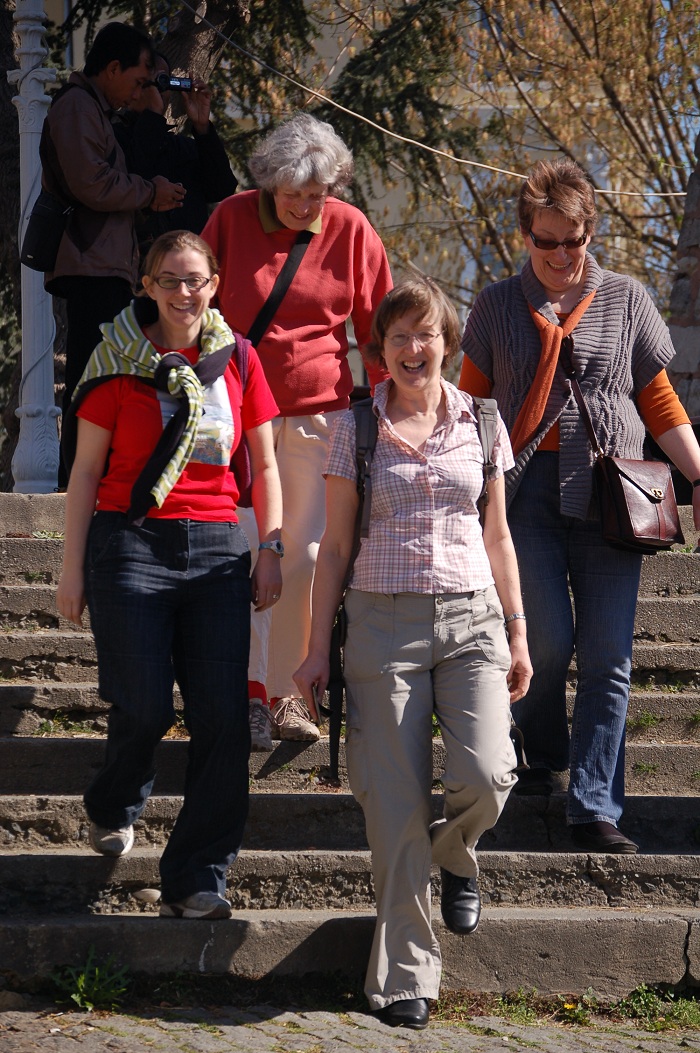
On Monday, I returned to work after a wonderful break in Istanbul with family.  I was so grateful for the warmth of the sun as well as for the beauty of the city, including its mosques and palaces.  The photo above (of my mother, me, my sister-in-law and niece) may give you some sense of our sunshine and good cheer.

In between catching up in my office and generally getting stuck in, I found myself glued to radio and television following the death of Baroness Margaret Thatcher, a towering and iconic figure in British and indeed global politics, one who divided a nation – the Marmite of twentieth century politics in Britain.  The hurt that some people still feel, especially in Britain’s former mining communities, is so great that some have lost sight of the basic human experience of bereavement and have openly celebrated her death.

I wonder if Britain’s current generation of beleaguered CEOs feels some empathy for the challenges Thatcher faced when she took on the leadership of the Conservative Party in 1975 and became Prime Minister in 1979.  Many commentators in the last 48 hours have pointed to aspects of life in Britain in the 1970s as an important backdrop to understanding Thatcher’s role in British politics.  Thatcher came to power at a time of economic turmoil and industrial unrest – bitter disputes between government and unions.  In 1974, for example, having failed to win the battle with Britain’s coal-miners, the UK government imposed a three-day working week for commercial users of electricity.  In 1979, Thatcher’s rise to power followed Britain’s “Winter of Discontent”, when fresh industrial action included action by dustmen which left rubbish piling up in the streets of London.  The Conservative slogan Labour Isn’t Working struck a chord with voters who gave Thatcher a 44-seat majority in the 1979 general election.  In 1979 Thatcher herself said she couldn’t bear Britain in decline.

As I write, I feel humble in the face of any commentary on Thatcher’s leadership which was, itself, controversial.  Instead, I allow myself a few reflections on aspects of her leadership and compare them with what I see in some of today’s CEOs.

Vision and principles

As a leader, Thatcher’s approach was grounded in a vision of a more prosperous Britain and in her firm beliefs about what it might take to get there.  True to her roots, she was able to extrapolate from her childhood as a grocer’s daughter and to understand that Britain needed to balance the books – a lesson that politicians and businessmen and women all over the world are currently and painfully having to learn again.  Thatcher also took the view that the ideals of her socialist opponents were best fulfilled via prosperity for the country as a whole – that Britain could not fulfil its aspirations to care for those in need without, first, generating wealth.

Today, CEOs are having to refresh their vision for the organisations in their charge, stripping them back to a bare minimum.  For clients I work with, this bare minimum includes core aims of the organisation and activities which support those aims.  It also includes stripping away excess cost.  It also includes managing risk and ensuring compliance with core external requirements.  Stripping a vision back in this way creates clarity for organisations which have been or might otherwise be in crisis.  The message is not always welcome and, nonetheless, it is clear.

Personal transformation

Thatcher’s steadfast adherence to her vision and underlying principles were such that, when Captain Yuri Gavrilov described her as an Iron Lady in 1976, the nickname stuck.  At the same time, whilst steadfast in her political beliefs, Thatcher was the queen of personal transformation.  Famously, she received vocal coaching from the National Theatre’s voice coach, lowering her voice to achieve greater gravitas and authority.  Later, as aspiring leader and PM, Thatcher toned down her hair colour because she understood that her platinum blonde was too strident.  Later still, her wardrobe was transformed under the direction of Margaret King, who became her stylist in 1987.  

In the modern world of leadership, few CEOs would go to such lengths.  Even so, the most effective leaders understand that whilst they need to promote a clear vision, they need to be flexible about the means to achieve their vision, adjusting their approach in the light of new information or to meet the needs of a specific situation.  If their message is not getting across, they think about how to change their communication and influencing approach so that it can be more easily heard and understood.

Building a leadership team

Commentators note that when she became leader of the opposition in 1979, Thatcher’s cabinet was comprised entirely of the supporters of her exiled predecessor, Edward Heath.  Her response was to quietly replace them, creating a new cabinet.

The new CEO always faces the challenge of legacy and has to manage a tricky balance in order to create an effective leadership team.  The history that comes with the “old guard” can act as a barrier to change, even at the most senior levels.  There may also be questions of capability – does the inherited team have the capability needed to achieve important goals for the organisation?  At the same time, the old team often has a fair dose of organisational savvy – team members know how things get done around here.  Bringing in new team members can create a time delay whilst “newbies” get up to speed and poor recruitment decisions can also impede progress.  It takes great skill to proceed effectively as a new, incoming CEO.

Addressing the “enemy within”

Thatcher saw the unions as Britain’s “enemy within” and her most bitter opponents include many former miners and their relatives.  She was concerned about the power held by union leaders which she saw as anti-democratic.  She was also concerned about the impact on the nation’s economy of strike action.  Two years after winning the Falklands War she took on the miners – and won.

In 21st century Britain, CEOs who have set tough challenges for their staff nonetheless seek to work with them to achieve their aims.  Approaches like “LEAN” seek to maximise value whilst minimising waste.  At its best, this approach exemplifies the distribution of roles and responsibilities:  CEOs set targets for the organisation which are broken down for execution by leaders throughout the organisation.  Leaders, in turn, work with their staff to identify ways to meet these targets.  In the modern era the enemy within is more likely to be excess cost or bureaucracy than some powerful lobby of people.

Drawing on personal support

It’s lonely at the top.  This phrase is no less true for being a well-worn cliche.  Behind the scenes, Britain’s Prime Minister was supported by her loyal husband whom she described as “my Denis”.  An article in the Independent told how Thatcher once said of her husband:  “I couldn’t have done it without Denis.  He was a fund of shrewd advice and penetrating comment.  And he very sensibly saved these for me rather than the outside world.  I think the marvellous thing is that he gives me a sense of perspective.  If I am upset or think I have done something silly, we talk about it and he makes me see sense”.

In the modern era, people increasingly understand the need to have the right personal support.  The modern CEO may well be supported by husband or wife or by others in his or her life who have been tested in long relationships – former colleagues, for example.  Equally, support may come in the form of a well-chosen coach or mentor.

Leading by example

I may be wrong and still, “hypocrisy” is not a word I associate with Margaret Thatcher, nor one used by her detractors.  A proponent of sound financial management in the country as a whole she is said to have practised great frugality in her official residence – Wikipedia notes that she even insisted on paying for her own ironing board.  It is, perhaps, this congruity between speech and action that underlines the current fashion for “authentic leadership”.

In closing, I ask for your reflections on Margaret Thatcher’s leadership.  What do you see as her greatest strengths in the role of leader?  I also pause to remember with compassion the human being – the woman – who has been lost to her family.


The fears that keep us working harder than we need to

I’m away this week, writing this blog posting ahead of time and scheduling it for publication on the day after the Easter Monday Bank Holiday.  As I write I am savouring the prospect of a short trip to Istanbul, with my mother, brother and family.  I have long since identified Istanbul as a place I’d love to visit.  I am also looking forward to a week in which my main focus is not work but play – a combination of spending time with loved ones and exploration.
In the run-up to my departure, I have been inviting discussions with my colleagues in the awareness that the heart of my work centres on helping leaders to do what they do with ease as well as with good results.  Often, my work is about helping clients to identify the next stage of their career and to move easily towards it.  For some, this movement towards is imbued with ease.  For many it is not.  So, my question to my colleagues is this:  what is it that keeps us working harder than we need to in order to achieve results?  I’m not talking about the kind of hard work we put in because we are engaged and inspired – what some call “discretionary effort”.  I’m talking about times when we struggle to achieve the outcomes we long for.  I’m talking about times when we work long hours but with little to show for it in terms of our desired outcomes or the way we feel.  I’m talking about the dialogue that goes round and round in circles and still, fails to lead us to the outcome we most need.  The list could go on…
Today, as I write, I am struck by a couple of resources highlighted to me by colleagues.  The first is a blog posting about a man called Simon Sinek whose name is new to me.  This led me in turn to a talk by Simon on www.TED.com – not just any talk but, at the time of writing, TED’s 7th most watched video ever.  In this talk, Simon outlines the simple difference between those leaders and organisations which manage to engage and inspire and those that, no matter how fantastic their product, fail to gain a foothold in the marketplace.  This is what Goleman and colleagues describe as the visionary leadership style in their book, The New Leaders.  This is what inspires the discretionary effort from staff.  This is what engages – excites, even – a tribe of loyal customers.
My question, though, was about the opposite side of the coin.  What is it that keeps us working too hard – struggling – to achieve results?  I was delighted to be pointed to this posting, entitled The Fears Leaders Never Speak Of (And How AQAL, Zen, And The Chinese New Year Can Help).  In this posting, author Ginny Whitelaw points us to the fears that sit beneath our efforts – fears that are often unrecognised and in this way given the power to drive our behaviour.  She also gives an intriguing recipe for responding to our fears which has the potential to empower us in the most counter-intuitive way.
But hey, I’m on holiday right now.  If you want to know more, you’ll have to read the bog postings and watch the TED talk.
Mmmm… 

The art of asking

In recent weeks, I confess I have engaged in a classic response to challenging times – going shopping.  It all started with a tea pot in Oxfam in Blackheath.  I loved it so much that, having bought it, I started to look for other items to match.  I uncovered the name of the pattern, discovered places to buy this pattern (long since discontinued) and have quickly built up a collection.  I have even, finally, succumbed to having cupboards and shelves built in my dining room.  This has given storage space for my new collection, it has been designed to display some of my new items, and it has also given storage for just some of the books around the house because, yes, I am also a bibliophile par excellence.  I can rationalise that I have been meaning for a while to replace some of my tired old china and this has been the opportunity to do it.  At the same time, I notice that this period of intense activity has followed the death of my uncle, distracting me from some of the feelings of grief and loss that came with it.
This collecting frenzy has also had an interesting side-effect, because in order to build my collection, I have had to ask for help.  It started when I posted some photos of my tea pot on Facebook and asked if anyone was clearing out their collection.  A number of friends responded with sources of information about this pattern (Denby arabesque) and pointed me to places that sell it.  For the first time, I ‘discovered’ eBay.  I bought a bowl, for collection only, from someone who lives near my younger brother, leading me to ask him if he’d be willing to collect it.  And then another from someone who lives near my older brother so that, once more, I found myself making a request.  I bought a large collection some miles away and asked a friend with a car (who keeps a car in London?  My friend Alan) if he would be willing to drive me.  The list goes on.
The tenderness of asking for help
Making requests of my friends and family – and so many requests of so many friends and family – has reminded me of the tenderness and sense of vulnerability that comes with asking for help.  Yes, I’m talking about me.  But I’m also talking more generally.  I would even go so far as to say that we live in a culture which frowns on the honest request.
In case you doubt this assertion, here are just a few examples of the ways in which we have learnt to bypass making requests – which I share alongside the invitation to notice how many you use yourself or notice in others:
  • One way that springs to mind is to make a “requorder” (“Take this to the post room, will you?”  “Get this done by five o’clock, won’t you?”).  This is an order or instruction embedded within a request.  Beloved of parents, managers and other figures of authority, the desired response is implied in a way which makes it just a bit more difficult to say no than an open honest request;
  • Another way is to hold in mind an expectation that is never openly shared (“Any normal manager would have noticed how upset John was feeling”  “Who on earth would turn up to such an important meeting without preparing?”  “Do you think anyone has told her that trying to go through a 60-slide deck in half an hour was bound to bore the pants off everybody?”);
  • Giving feedback is also often a way of making a hidden request (“This document is in a terrible state.  I found at least six mistakes on every page – it’s just not up to scratch!”);
  • And of course, there’s always the option of giving an order (“You need to complete this document by 5 o’clock at the latest!”  “Make sure everyone has the minutes at least two days in advance”).

As ways of getting things done, these tactics vary in their ability to achieve a desired outcome.  One of the least successful is to complain around the water-cooler (or at home to our husband or wife):  talking about what someone should have done or should do in future rarely leads to a change of behaviour on the part of the person concerned.  More successful is the option of giving an order – at least in the short term.  Over time, though, the use of a coercive style of leadership can have a corrosive impact on how people feel at work.  (If you haven’t already read it, read Daniel Goleman’s article Leadership That Gets Results for an introduction to research in this area.)

Having said this, one thing that all these approaches delivers is this:  it protects us from all the feelings we have when faced with the possibility of a “no”, and one laden with judgement at that.  For many, our feelings of tenderness and vulnerability when making requests reflect all sorts of experiences from our earliest years.
The art of asking
This blog posting takes its heading from a talk on TED.com by singer Amanda Palmer.  If you recognise the challenge of making requests or find yourself wondering if some of the strangest behaviours of those you lead come from avoiding making requests, then you may enjoy hearing what she has to say.  For my part, these are a few things that work for me when I’m making requests:
  • Recognise my emotions around making a request:  There are times when the thought of making a request brings up some emotion for me.  An example of this is the anger I feel when faced with a car, loud music and a number of teenagers in the car park opposite my house at bed-time.  I always start by noticing my emotion and noticing what the emotion is;
  • Get clear about what I really want:  With the young people in the car park, for example, I may recognise how early I need to get up the next morning and how much I’m longing for sleep.  I want to be confident that when I go to bed in a few minutes time I’ll be able to sleep without a background noise of voices and loud music.  This is a way of giving myself empathy and tends to soothe the emotion.  It’s also important to help me make a request that really does meet my needs;
  • Think about different ways of getting what I really want:  As long as the only way for me to get to sleep is to get those youngsters out of the car park, it’s difficult for me to make a request rather than a demand:  I know people sense the energy of a demand behind the words of a request.  Thinking about a variety of ways forward makes it easier for me to make a request.  Before I make a request, I take time to think about different options;
  • Get curious about what others may have on their minds:  The kids in the car park have a reason for being there.  Taking time to imagine what those reasons may be helps me to connect with others as and when I do decide to make a request.  And because I still remember my mother telling me “I want, doesn’t get”, it helps to remind myself that actually, we all like to contribute to the well-being of others;
  • Get clear about what I want to request:  Sometimes, the request I end up making is not the one I first thought of.  I’ve learnt, for example, to ask the youngsters in the car park how long they’re planning to be there and to explain why that’s important to me.  They might feel unhappy to be asked to leave right now, but it’s hard to find a reason not to share their intentions.  In the workplace, I may want someone to do something for me but first, I want to know if there’s anything standing in the way.  Often my first request is a request for information about the other person (“Is this something you’d be willing to do?” “How does this idea land with you?”);
  • Make the request when I can easily accept a yes or a no:  Especially when my start-point has been one of emotion, I take time to reach a point when I can hear a yes or a no with equal ease before I make the request.  Only at this point do I open the door and walk across the (real or metaphorical) car-park;
  • Make a simple action-request:  I may say hello and check in.  Quite quickly though, I cut to the chase.  I make my request and explain why it’s important to me.  I make sure my request is specific – describing the action I want someone to take.  Then I wait for – and welcome – the answer.

I recognise that there may be unanswered questions for you.  (“What about when you do need the report done by 5pm?”  “What about the staff member who always says no and needs to say yes?”).  Please ask me those questions in the comment box below and I promise to write a response.  For now, though I wonder – how do you manage the art of asking?

A different kind of business development

There has been a certain amount of laughter in recent weeks in my Mastermind Group as we recognise something we have come affectionately to refer to as a “different kind of business development”.  These are the moments when something in our lives seems to take us away from those activities we have on our “to do” lists – when a major decision brings up emotion we did not expect, for example, so that the last thing we want to do is to “set to” and work our way through our well-honed plans, or when the needs of a loved one – an illness, operation, or a death with everything that it brings – reminds us of priorities which seem to have nothing to do with business, or when the pain we feel about past events in our lives stands up and demands attention.
Sometimes the business of the day is not business
There’s a task that no headteacher wants to face and yet, when it comes, recognises that it is the most important task of the day.  The death of a child who is a pupil in your school cannot be ignored.  Instead, it requires your attention and that of the children in your care.  Assemblies represent an opportunity to remember the child who is lost, as do books of condolence.  Teachers know to look out for signs that children are distressed and not coping and to make time for conversations or just to be present to each child and his or her experience.
In the adult world, there is a risk that we fail to see that we still need the same kind of love and care.  There is also a risk that we fail to recognise the myriad moments when such love and care is needed.  Perhaps the time comes when we lose a loved one through death or separation and divorce.  Equally, it may be the events in our business that stimulate emotion – the threat of redundancy, for example, or even the uneasy guilt that comes with keeping your job when others have lost theirs.
Sometimes the stimulus for distress or some other emotion is in the minutiae of our daily working lives.  It is some task we find ourselves postponing even though we know, rationally, how urgent or simple it is.  It is the fact that, “yet again”, our colleagues in XYZ department have… well, you get the gist.
The perils of “powering through”
In a culture that favours logical thinking and purposeful action, we can tell ourselves that we have to power our way through these tender moments.  Yes, we have suffered a death, but we have to do our bit at work, people will think ill of us if we don’t, we have a mortgage to pay, and who will do it if we don’t?  These and other thoughts lead us to put aside our feelings and move quickly to action.  Some may even encourage this approach, teaching us to favour action over reflection or to dismiss those parts of ourselves that are not on board.
Powering through does have its downsides.  Sometimes, the failure to slow down and reflect means that we fail to get to the bottom of a problem or issue and find ways to handle it that work.  Sometimes, powering through causes the accumulation of stress and leads to illness.  One friend powered through against all advice following first the death of her father and then the breakdown of her marriage – only to come to a complete halt when she succumbed to ‘flu.  A fellow user of the Hogan suite of tests, which are often used for recruitment and development at the most senior of levels, is always alert to clues in the tests’ results that might point to stress or illness.
Powering through can also have another effect – the effect of reinforcing old messages from childhood.  Your needs don’t matter.  Part of you is worthy – but another is not.  The very denial of our feelings and experience evokes unmet needs, the pain that goes with those unmet needs, and ways to cope that we designed when we were just two, or three or six years old.
Responding effectively to the business of the day
It takes faith to respond effectively to the business day.  I am not talking about religious faith – though this may be important to you.  No, I am talking about an ability to attend to the business of today in the belief that it will move you forward in ways you cannot yet see.  This is about understanding that your staff need to attend to their grief following your most recent round of redundancies as part of coming to terms and even engaging with a new organisation with a new agenda.  This is about trusting that supporting John in caring for his dying wife will not only help him through but also lead to the best, albeit as yet unknown, outcome for your business.
As a leader, responding effectively to the business of the day begins with you.  It begins with you being aware of and taking care of your own business.  You need to put on your own oxygen mask before you can help those you lead.  Take time to notice those things in your life that really are your business for today.  Take time to respond to the needs you have that may not fit easily into a “to do” list or 30-day plan.  And yes, take time to notice those times when your team or members of your team have business to attend to and think carefully about how to respond.
And whether you are dealing with your own business or responding to the needs of your team, think carefully about the implications of powering through and ask yourself, instead, how you can bring a quality of compassion that brings healing to a person or situation.
I wonder, what is your business for today?

On power and corruption


A story has been unfolding in the news in recent weeks which caught my attention.  It’s the story of Scottish Cardinal Keith O’Brien.  I wonder what lessons this story holds for us in the workplace:  I have a few thoughts of my own and I also invite you to add your comments below.

In case you’ve missed it, the bare bones of the story are as follows.  Cardinal O’Brien, who has been a vociferous opponent of gay rights and was named “bigot of the year” last year by Colin MacFarlane, director of Stonewall Scotland, came unexpectedly into the spotlight in recent weeks.  On 23rdFebruary, the Observer newspaper published an article which was initially robustly rebutted by the cardinal, reporting that the cardinal, throughout the course of his career, had made unwanted sexual advances to at least one former and three currently serving priests for whom he had formal responsibility.  Two days later the Scottish Catholic Media Office issued a statement that the Pope had accepted Cardinal O’Brien’s resignation on 18th February, 2013, to take effect from February 25th.  The media was quick to notice and highlight the implications of this announcement – that Cardinal O’Brien, who was already due to retire in March, would not now take part in discussions to appoint Pope Benedict XVI’s successor.

Catching various discussions of these latest revelations in recent days, I have been struck by the lack of sympathy for O’Brien.  Commentators have speculated that his hard-line stance against homosexuality is not only a reflection of the official position of the Catholic Church but also an indication that the cardinal has been in deep denial of his own sexuality and sexual orientation.  They have pointed to his lack of honesty in responding to the Observer’s article and to the sparseness of his apologies.  No apology to the Observer for initially threatening legal action when they published an article which turned out to be true.  No apology to gay men and women for the impact on them of his outspoken comments against homosexuality.  It seems that, at the very moment that Cardinal O’Brien is at his most vulnerable, there is scant sympathy for him in the public domain.

What’s all this got to do with the wider world of work?  These are some of the things I take from Cardinal O’Brien’s story:

People in positions of power wield it for personal gain:  Again and again, history tells us how people can use and misuse the power of their position.  We can all name famous historical examples in the world of politics and in the world of business.  These are examples of men and women who, no doubt with positive intentions, take actions which shock us when they are revealed.  From Hitler to Fred (“the shred” and later “the bed”) Goodwin.  Cardinal Keith O’Brien is just one of a long line of people who have used the power of their position for personal gain.

The fall of a leader reveals their “dark side”:  Some readers already know that I have recently signed up to train to use the Hogan suite of tests for the assessment of senior leaders.  One of these tests is rooted in research that shows that when senior executives fail, it is often because they have a characteristic or characteristics which, when not acknowledged and managed appropriately, presents a risk in increasingly senior roles.  It seems that Cardinal O’Brien failed to acknowledge and manage the full range of his own personal characteristics and that this is the cause of his recent downfall.

Organisations struggle to manage accountability:  Pope Benedict XVI’s papacy has been beset by the legacy of the Catholic Church’s failure to manage accountability whilst also revealing the unwanted legacy that such a grand-scale failure can leave in its wake.  It seems to me that organisations struggle most to manage accountability at senior levels, both because it is senior employees who hold the power and because of the risks to the organisation of addressing infringements.  At the same time, it is an organisation’s ability to manage accountability – including at senior levels – that secures its legacy.

People still need to wield power:  In working with senior leaders, I notice that some have values which include the rejection of power.  It seems that we fear the harmful effects of power.  (One recent example has been the refusal of Angela Merkel and her fellow senior German politicians to exercise power in the economic domain.  Europe sees Germany as holding the keys to a brighter economic future.  Germany fears repeating the mistakes of the past).  This refusal to wield power carries the risk that it is those people most likely to abuse their power who end up in powerful positions.  For me, the answer is not to aspire to an organisation without power but, instead, to help people to use the power of their position for the good of the organisation.
Personal failings can reveal the need for a wider transformation:  Again and again we have learned not only of sexual abuse by priests but also of a failure to hold priests to account – at great cost to those (often children) who have been the object of unwanted sexual advances.  Whilst examples in other organisations may be different (the rogue trader in banks, the corrupt politician, the fraudulent employee) the revelation of a misdemeanour tells us a great deal about the organisation and its need for a wider transformation.

At the moment of an employee’s downfall, we get to choose our response:  I want to finish with this last point because it is the one most close to my heart.  It seems to me that understanding the impact on one individual of another’s actions does not need to equate to a wholesale condemnation of the person concerned.  We are all far more than the sum of our actions.  Cardinal Keith O’Brien is on the cusp of a spiritual journey which, I hope, leads him to greater compassion for self and others.  My own experience has been that we are most able to hold ourselves and each other to account when we can bring compassion to the most challenging of circumstances.  The media response to recent revelations reflects a deep, deep need for understanding on the part of those who have been verbally and sexually abused.  I recognise that need and still, I believe it can be expressed in other ways.